Preparing for CLAT 2027 is not just about covering the syllabus—it is about understanding the exam pattern and preparing strategically. Every year, thousands of aspirants spend months studying, yet only a few secure admission to the top National Law Universities (NLUs). The difference often lies in knowing what to study and how to study it.
Among the most important skills tested in CLAT are Analytical Reasoning and Critical Reasoning. While both evaluate logical thinking, they assess different abilities and require different preparation strategies. Many aspirants often wonder:
Should I focus more on Analytical Reasoning or Critical Reasoning for CLAT 2027?
The short answer is both, but if you're looking to maximise your score based on the latest CLAT pattern, Critical Reasoning deserves greater attention, while Analytical Reasoning should remain an integral part of your preparation.
Let's understand why.
What is Analytical Reasoning?
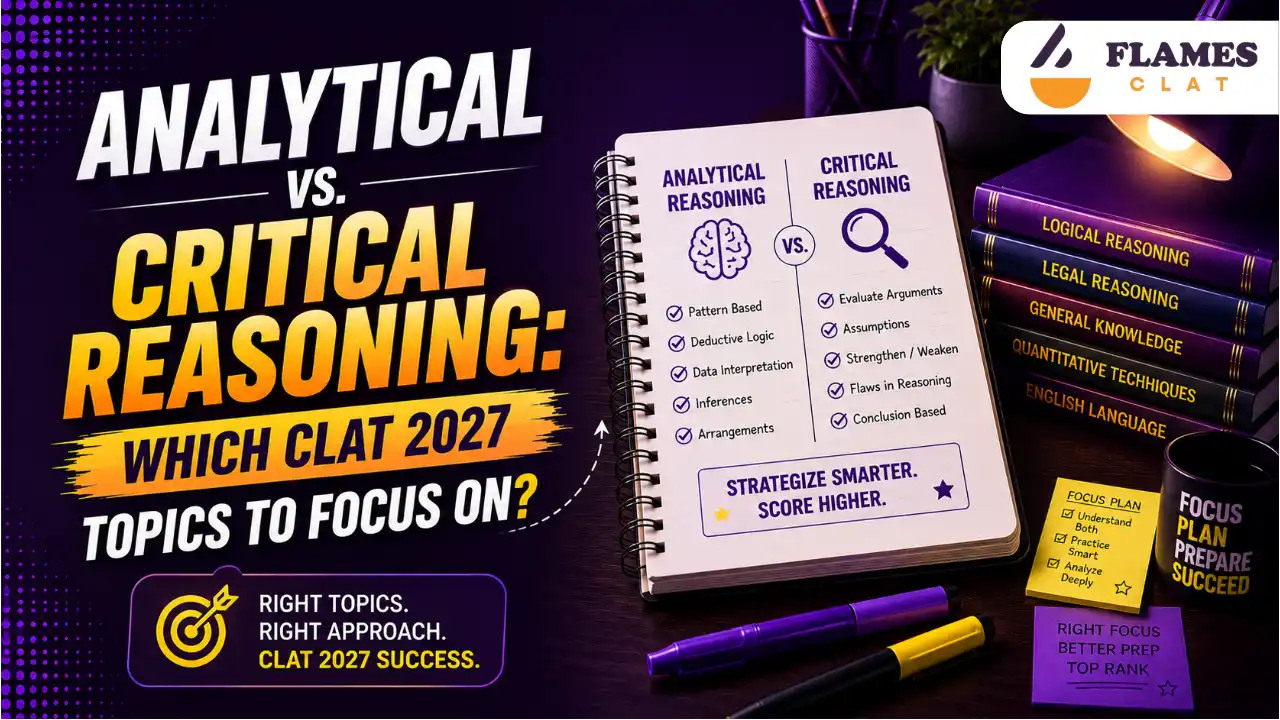
Analytical Reasoning measures your ability to identify patterns, organise information, solve structured problems, and reach logical conclusions. These questions are usually based on a fixed set of conditions where you must analyse relationships and eliminate incorrect possibilities.
Some of the most important Analytical Reasoning topics include:
- Seating Arrangements
- Linear & Circular Arrangements
- Blood Relations
- Direction Sense
- Coding-Decoding
- Syllogisms
- Ranking & Ordering
- Statement and Conclusions
- Logical Sequencing
- Puzzles
Analytical Reasoning rewards practice and consistency. The more varieties of questions you solve, the quicker you become at recognising patterns and arriving at accurate answers.
Apart from CLAT, these concepts are also useful for other law entrance examinations and competitive exams that continue to include traditional logical reasoning questions.
What is Critical Reasoning?
Critical Reasoning is fundamentally different from Analytical Reasoning. Instead of solving puzzles, it tests your ability to understand, analyse, evaluate, and interpret arguments.
Rather than asking you to identify patterns, Critical Reasoning expects you to think like a lawyer- examining facts, questioning assumptions, evaluating evidence, and drawing reasoned conclusions.
Some of the major Critical Reasoning topics include:
- Assumptions
- Strengthening an Argument
- Weakening an Argument
- Inference-Based Questions
- Conclusions
- Cause and Effect
- Course of Action
- Statement Analysis
- Argument Evaluation
- Logical Fallacies
These questions assess your reading comprehension, logical judgement, and decision-making skills rather than your ability to memorise techniques.
Why Critical Reasoning is More Important for CLAT 2027
The Consortium of NLUs has significantly transformed the CLAT examination over the past few years. The emphasis has shifted from direct, fact-based questions to comprehension-driven, application-oriented questions.
Today's CLAT expects candidates to:
- Read lengthy passages efficiently.
- Identify assumptions hidden within arguments.
- Draw logical inferences.
- Evaluate multiple viewpoints.
- Apply legal principles to factual situations.
- Think critically under time pressure.
This shift means that Critical Reasoning is no longer confined to the Logical Reasoning section alone.
It directly influences your performance in:
Legal Reasoning
Legal Reasoning requires you to apply legal principles to factual situations rather than simply recalling legal provisions. Strong critical thinking helps you identify relevant facts and apply the law accurately.
English Language
The English section increasingly focuses on comprehension-based questions where candidates must infer meanings, identify the author's perspective, understand arguments, and evaluate statements.
Current Affairs & General Knowledge
Even Current Affairs questions often demand contextual understanding rather than simple memorisation. Being able to analyse information critically can make a significant difference.
In other words, improving your Critical Reasoning skills enhances your performance across multiple sections of the CLAT paper.
Should You Ignore Analytical Reasoning?
Absolutely not.
While Critical Reasoning aligns more closely with the current CLAT pattern, Analytical Reasoning remains essential for developing structured logical thinking.
Regular practice of Analytical Reasoning helps improve:
- Speed
- Accuracy
- Logical consistency
- Concentration
- Pattern recognition
- Decision-making under pressure
Moreover, if you plan to appear for examinations like AILET, SLAT, MHCET Law, or other law entrance tests, Analytical Reasoning continues to be highly relevant.
Think of Analytical Reasoning as building the foundation of your logical ability, while Critical Reasoning teaches you how to apply that logic effectively.
How Should You Prepare for CLAT 2027?
Instead of choosing one over the other, maintain a balanced preparation strategy.
1. Prioritise Critical Reasoning
Spend more time solving passage-based reasoning questions and analysing arguments.
2. Read Daily
Develop a habit of reading newspapers, editorials, and opinion pieces. This improves both comprehension and analytical thinking.
3. Practice Analytical Reasoning Regularly
Even 20–30 minutes of daily puzzle-solving can significantly improve your logical aptitude and speed.
4. Attempt Mock Tests
Mock tests simulate the actual examination and help improve time management, accuracy, and confidence.
5. Analyse Your Mistakes
Don't just check the correct answers—understand why you got a question wrong. This is where real learning happens.
6. Stay Consistent
Consistency beats intensity. A disciplined study routine with regular revision and practice will always produce better results than sporadic long study sessions.
If you're preparing for CLAT 2027, your preparation should reflect the evolving nature of the examination.
The current CLAT pattern clearly favours candidates who can read carefully, analyse arguments, evaluate information, and apply logic effectively. This makes Critical Reasoning one of the highest-priority areas in your preparation.
However, Analytical Reasoning should not be overlooked. It strengthens your logical foundation, improves accuracy, and develops the problem-solving skills required not only for CLAT but also for several other law entrance examinations.
The ideal strategy is simple:
- Master Critical Reasoning because it aligns closely with the modern CLAT pattern.
- Practice Analytical Reasoning consistently to maintain speed and strengthen logical thinking.
- Take regular mock tests to apply both skills under exam conditions.
Success in CLAT is not about studying every topic equally—it is about preparing intelligently, practising consistently, and adapting to the exam's evolving demands. A balanced approach to Analytical and Critical Reasoning will help you maximise your score and move one step closer to your dream National Law University.
Test Your Preparation with FLAMES CLAT!
Understanding concepts is only the beginning—consistent practice is what turns preparation into success.
If you're serious about cracking CLAT 2027, put your preparation to the test with our FREE Monthly CLAT Quiz. Curated by experienced mentors, the quiz is designed to help you assess your strengths, identify areas for improvement, and experience questions that reflect the latest CLAT pattern.
📝 Attempt the FREE Monthly CLAT Quiz:
https://www.flamesclat.com/monthly-quiz
At FLAMES CLAT, we're committed to helping every aspirant prepare smarter through expert mentorship, comprehensive study resources, mock tests, current affairs updates, strategy sessions, and daily practice content.
Stay connected with us and take your preparation to the next level:
▶️YouTube: https://www.youtube.com/@flamesclat
📲 Telegram Community: https://t.me/WH6RLT10jpAmH3XR
Your journey to a top National Law University starts with the right guidance and consistent effort. Join the FLAMES CLAT community today and take the next confident step towards achieving your CLAT 2027 dream.