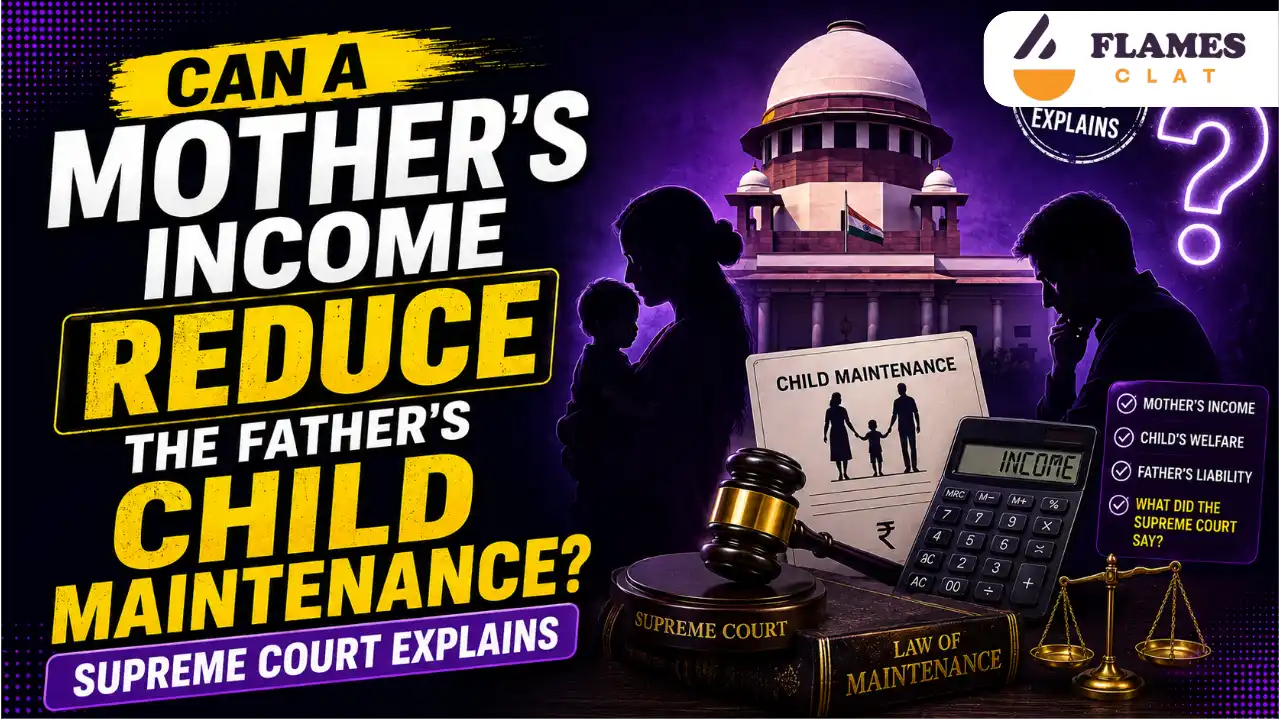
A recent Supreme Court judgment has brought an important question in child-maintenance law into focus: if the mother is earning, can the father’s financial responsibility towards his children automatically be reduced? In Sujata Kumari & Ors. v. Rahul Kumar & Anr., decided on 20 August 2026, the Supreme Court made it clear that the answer is not automatically. The Court held that the fact that the mother earns an income, by itself, cannot be used as a reason to halve the father’s liability towards the children.
What Was the Case About?
The case concerned a couple who were both doctors and had two minor daughters, approximately eight and nine years old. The mother, a qualified gynaecologist, was earning around ₹1.5 lakh per month, while the father, a consultant paediatrician, disclosed an income of around ₹2 lakh per month. The children were living with their mother.
The wife had initiated proceedings under Section 125 of the Code of Criminal Procedure, 1973, seeking maintenance. The Family Court awarded interim maintenance of ₹30,000 per month for each daughter, making the total ₹60,000 per month. The Family Court, however, did not award interim maintenance to the wife herself, considering her own income.
What Did the High Court Decide?
The matter subsequently reached the Allahabad High Court. The High Court reduced the maintenance payable for each daughter from ₹30,000 to ₹15,000 per month. One of the considerations was that the mother was also earning and that the responsibility of maintaining the children was shared by both parents.
This raised an important question: Can the mother's income alone justify cutting down the father's contribution towards the children's maintenance?
What Did the Supreme Court Say?
The Supreme Court disagreed with the approach adopted by the High Court and restored the Family Court's order of ₹30,000 per month for each daughter.
The Court emphasised that while both parents have a responsibility towards their children, that responsibility cannot be divided by arithmetic alone. Simply comparing the parents' salaries and mechanically dividing the financial obligation does not provide a complete picture of the children's needs or the contributions made by each parent.
The Court also recognised that the mother was living with the children and taking care of their daily needs and upbringing while continuing to work. Such caregiving is a genuine contribution, even though it may not appear as a monetary payment.
Why Was ₹60,000 Considered Reasonable?
The Supreme Court looked at the circumstances of the case rather than applying a fixed mathematical formula. The children were school-going and their education and upbringing involved substantial expenditure. The father had himself disclosed an income of approximately ₹2 lakh per month.
Considering the status of the parents, the children's needs, their education and upbringing, and the father's disclosed income, the Court found that ₹60,000 per month for both daughters was just and reasonable. It therefore restored the Family Court's original order.
Importantly, the Court's decision concerned interim maintenance. It did not finally decide the main maintenance proceedings on their merits.
Does This Mean the Mother Has No Responsibility?
No. This is an important distinction.
The Supreme Court did not hold that an earning mother has no responsibility to support her children. The obligation to maintain children is shared by both parents. What the Court rejected was the idea that the mother's income should automatically result in a proportional reduction of the father's liability.
The Court's approach was more holistic. The financial capacity of both parents matters, but so do the children's actual needs and the non-monetary contributions made by the parent who is primarily caring for them.
Why Is This Judgment Important?
The judgment is significant because it moves away from treating child maintenance as a simple 50:50 calculation between parents. A child's needs do not necessarily become half simply because both parents earn an income.
It also highlights an important aspect of caregiving. The parent who lives with the children may contribute through daily supervision, education, healthcare, household responsibilities and other forms of care that cannot easily be converted into a salary figure. The Supreme Court recognised that these contributions have real value when assessing parental responsibility.
For law students and CLAT aspirants, the case is particularly useful for understanding how courts approach maintenance, parental responsibility, judicial discretion and the welfare of minor children.
The Bigger Legal Takeaway
The judgment does not establish a rule that fathers must always pay a particular amount of maintenance regardless of the mother's income. Instead, it makes an important point about how maintenance should be assessed.
Courts must look at the complete circumstances of the case—including the children's needs, the financial position of both parents, their respective contributions and the standard of living—rather than reducing the father's obligation through a mechanical calculation based only on the mother's earnings.
In simple terms, a working mother does not automatically mean a lower maintenance obligation for the father. The Supreme Court's decision in Sujata Kumari v. Rahul Kumar reminds us that child maintenance is ultimately about the welfare and needs of the child, not simply about comparing the salaries of two parents.
The Court's message is clear: both parents share the responsibility of raising their children, but that responsibility cannot be reduced to simple arithmetic.
For CLAT aspirants, this is also a useful example of how the Supreme Court applies legal principles to the facts of an individual case something that is at the heart of legal reasoning. A parent's income can be measured. A parent's responsibility cannot always be divided so simply.
Prepare Smarter with FLAMES CLAT
At FLAMES CLAT, we believe that staying updated with important Supreme Court judgments is an essential part of becoming a strong law aspirant.
📝 Take the FREE FLAMES CLAT Monthly Quiz:
https://www.flamesclat.com/monthly-quiz
▶️ Watch FLAMES CLAT on YouTube:
https://www.youtube.com/@flamesclat
📲 Join the FLAMES CLAT Telegram Community:
https://t.me/WH6RLT10jpAmH3XR
You don't need to know everything. You need to know how to handle what you don't know.