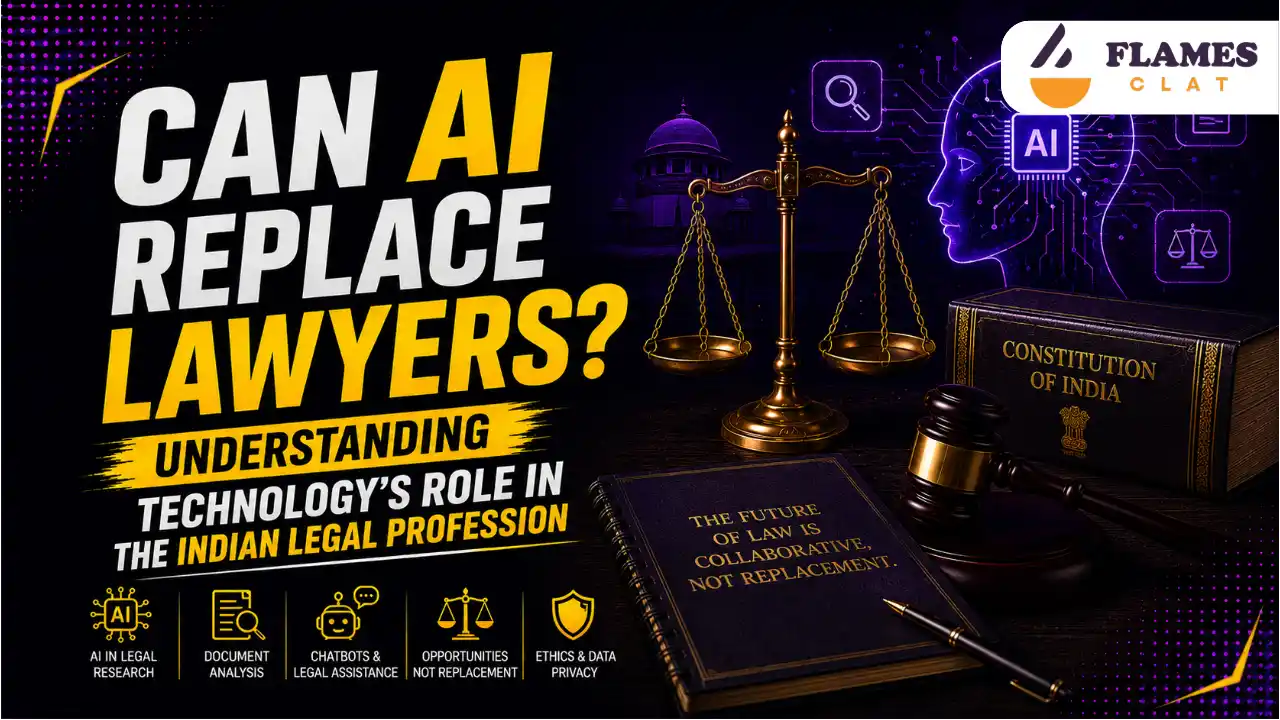
Artificial Intelligence has entered almost every professional field, including law. From legal research platforms and contract-review software to AI-powered chatbots and document-drafting tools, technology is changing the way legal work is performed. This has raised an important question among students and young professionals: Can AI replace lawyers?
The short answer is that AI is unlikely to completely replace lawyers. However, it is already changing the legal profession and will continue to affect the skills that future lawyers need to develop.
For CLAT aspirants and future law students, understanding the relationship between law and technology is becoming increasingly important. The legal profession of the future will not only require knowledge of statutes and judgments but also adaptability, analytical thinking, ethical judgment, and the ability to work effectively with technology.
What Is Artificial Intelligence in Law?
Artificial Intelligence refers to computer systems that can perform tasks usually associated with human intelligence. In the legal sector, AI can analyse large volumes of documents, identify patterns, summarise legal material, assist with contract review, organise case files, and support legal research.
AI tools can quickly search through judgments, legislation, contracts, and legal databases. This saves time in tasks that would otherwise require lawyers to read hundreds of pages manually.
For example, in a commercial dispute involving multiple contracts and emails, an AI tool may help identify relevant clauses, dates, names, and repeated terms. This can assist lawyers in preparing their case more efficiently.
However, AI does not independently understand justice, fairness, human emotion, social context, or professional responsibility in the same way that a lawyer does.
How AI Is Changing Legal Work in India
AI is already influencing several areas of legal practice in India. Law firms, corporate legal departments, and individual practitioners are increasingly using technology for legal research, document management, due diligence, contract review, and case tracking.
Some of the major uses of AI in the Indian legal profession include:
- Legal research and case-law analysis
- Contract drafting and review
- Due diligence in corporate transactions
- E-discovery and document review
- Legal document summarisation
- Compliance monitoring
- Case management and workflow organisation
- Client communication through automated systems
These tools can improve efficiency, reduce repetitive work, and allow lawyers to focus more on strategy, advocacy, negotiation, and client counselling.
Can AI Replace Legal Research?
AI can make legal research faster, but it cannot fully replace a lawyer’s legal reasoning. Legal research is not only about finding a case that contains similar words. It requires understanding whether a judgment applies to the facts of a particular matter, whether it has been overruled, whether it is distinguishable, and how it fits within the larger legal framework.
A lawyer must also assess the reliability of sources, interpret statutory provisions, identify conflicting precedents, and frame arguments based on the client’s specific situation.
AI may identify relevant authorities, but a lawyer decides how those authorities should be used before a court, tribunal, arbitrator, or regulatory authority.
Why Courtroom Advocacy Cannot Be Easily Replaced
Courtroom advocacy involves much more than presenting legal information. Advocates must respond to questions from judges, adapt arguments in real time, understand the mood of the courtroom, make strategic concessions, and persuade through clarity and judgment.
In litigation, facts are often disputed, witnesses may be unreliable, and the legal position may not be straightforward. A lawyer must decide which arguments to prioritise, how to cross-examine a witness, and how to respond to unexpected developments during a hearing.
These decisions involve professional experience, human communication, ethics, and strategic judgment. AI can assist with preparation, but it cannot fully replace the role of an advocate in a courtroom.
The Importance of Ethics and Confidentiality
The legal profession is governed by duties of confidentiality, professional conduct, and responsibility toward clients and courts. Lawyers handle sensitive personal, financial, commercial, and legal information.
The use of AI in legal practice creates concerns regarding data privacy, confidentiality, accuracy, and accountability. If an AI tool produces incorrect legal information or exposes confidential documents, a lawyer cannot simply shift responsibility to the technology.
Lawyers must verify AI-generated work, protect client information, and ensure that technology is used ethically. The human lawyer remains responsible for the advice given to the client.
Will AI Reduce Job Opportunities for Lawyers?
AI may reduce the amount of time lawyers spend on repetitive tasks such as sorting documents, reviewing standard contracts, preparing basic summaries, and conducting preliminary research. This could change the type of work available to junior lawyers.
However, AI is also likely to create new opportunities in areas such as technology law, data protection, cybersecurity, AI regulation, intellectual property, digital evidence, legal-tech entrepreneurship, and compliance.
The legal profession is evolving rather than disappearing. Lawyers who combine legal knowledge with technological awareness may have an advantage in the future job market.
Skills Future Lawyers Should Develop
To remain relevant in an AI-driven legal environment, future lawyers should focus on skills that technology cannot easily replicate.
These include:
- Legal reasoning and statutory interpretation
- Critical thinking and problem-solving
- Oral advocacy and negotiation
- Legal writing and drafting
- Client counselling and communication
- Ethical judgment and professional responsibility
- Understanding of technology and digital tools
- Research and fact-analysis skills
For CLAT aspirants, these skills begin with careful reading, logical reasoning, current affairs awareness, and the ability to analyse information from passages.
What CLAT Aspirants Can Learn from the AI Debate
The discussion around AI and lawyers shows that law is not limited to memorising provisions or recalling case names. Law requires interpretation, analysis, empathy, communication, and the ability to make decisions in complex situations.
CLAT preparation itself develops several of these abilities. Legal Reasoning teaches students to apply principles to facts. Logical Reasoning helps them analyse arguments. English Language passages improve reading and interpretation. Current Affairs develops awareness of legal, political, economic, and technological developments.
Students preparing for law entrance examinations should therefore focus on building skills, not merely completing topics.
Explore Free Practice Resources at FLAMES CLAT
Students who want to strengthen their Legal Reasoning, English, Current Affairs, Logical Reasoning, and Quantitative Techniques can explore the free quizzes available on the FLAMES CLAT website. Regular practice can help aspirants improve accuracy, develop consistency, and become more comfortable with the reasoning-based nature of CLAT.
Visit FLAMES CLAT Free Quiz Section to begin practising.
Indeed,
AI will not replace lawyers entirely, but it will change the way lawyers work. Technology can assist with research, drafting, document review, and administrative tasks, but it cannot fully replace human judgment, advocacy, ethics, strategy, and client trust.
The future belongs to lawyers who are willing to learn, adapt, and use technology responsibly. For aspiring law students, this is an opportunity to prepare for a legal profession that is becoming more efficient, more technology-driven, and more dynamic than ever before.
Test Your Preparation with FLAMES CLAT!
Understanding concepts is only the beginning—consistent practice is what turns preparation into success.
If you're serious about cracking CLAT 2027, put your preparation to the test with our FREE Monthly CLAT Quiz. Curated by experienced mentors, the quiz is designed to help you assess your strengths, identify areas for improvement, and experience questions that reflect the latest CLAT pattern.
📝 Attempt the FREE Monthly CLAT Quiz:
https://www.flamesclat.com/monthly-quiz
At FLAMES CLAT, we're committed to helping every aspirant prepare smarter through expert mentorship, comprehensive study resources, mock tests, current affairs updates, strategy sessions, and daily practice content.
Stay connected with us and take your preparation to the next level:
▶️YouTube: https://www.youtube.com/@flamesclat
📲 Telegram Community: https://t.me/WH6RLT10jpAmH3XR
Your journey to a top National Law University starts with the right guidance and consistent effort. Join the FLAMES CLAT community today and take the next confident step towards achieving your CLAT 2027 dream.