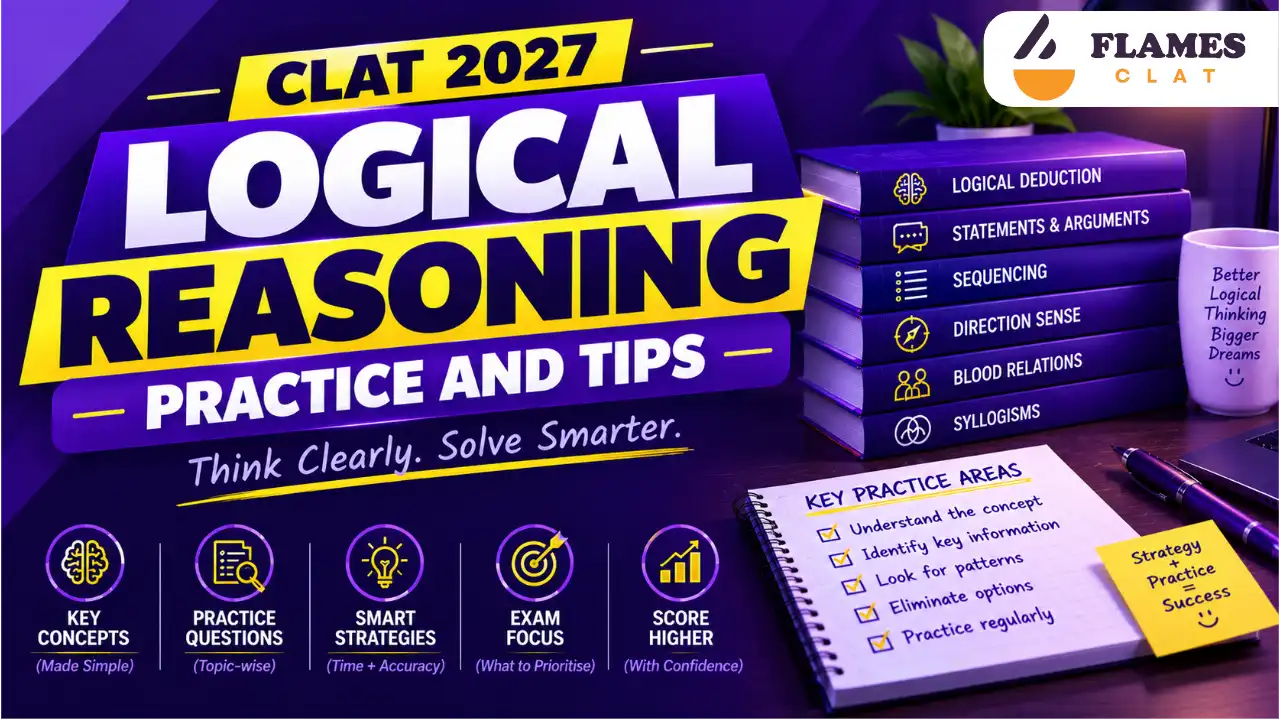
Logical Reasoning is an important part of CLAT 2027 preparation. It tests your ability to understand arguments, identify conclusions, recognise assumptions, and evaluate the logic presented in a passage. Rather than relying on personal opinions or outside knowledge, you need to focus on what the passage actually says and how its arguments are structured.
For many aspirants, the challenge is not understanding the passage but selecting the option that best fits the author's reasoning. With regular practice and the right approach, you can improve your accuracy, manage your time better, and become more confident while solving questions.
1. Read the Passage Carefully
Logical Reasoning questions are often based on passages discussing social issues, public policies, education, technology, or other topics. You do not need specialised knowledge of every subject. Your priority should be to understand the central argument and the relationship between the ideas presented.
While reading, identify the main point, the supporting reasons, and the author's position. Avoid getting distracted by examples or details that do not contribute directly to the argument.
2. Identify the Conclusion and Assumptions
Many Logical Reasoning questions test whether you can identify what the author is trying to establish and what the argument depends on.
The conclusion is the main point the author wants the reader to accept. Assumptions are ideas that the argument relies on but may not state directly.
Learning to distinguish between these two will help you approach questions on assumptions, inferences, and the overall argument more effectively.
3. Practise Different Question Types
Do not restrict your preparation to one type of Logical Reasoning question. Practise identifying conclusions, evaluating assumptions, strengthening or weakening arguments, drawing inferences, and understanding the author's reasoning.
Each question type requires a slightly different approach. The more familiar you become with these patterns, the easier it will be to understand what a question is asking and eliminate unsuitable options.
4. Avoid Personal Opinions and Outside Assumptions
One of the most common mistakes in Logical Reasoning is choosing an option because it sounds sensible in real life. However, an answer must be supported by the passage and must address the specific question.
Even if you disagree with the author's opinion, your task is to evaluate the reasoning presented. Always return to the passage when you are confused between two options.
5. Learn the Art of Option Elimination
Sometimes, multiple options may appear convincing. Instead of selecting the first answer that sounds correct, compare each option with the argument.
- Eliminate options that are irrelevant to the main argument.
- Reject conclusions that go beyond the information provided.
- Be cautious of extreme statements that the passage does not support.
- Check whether the option answers the exact question being asked.
Remember, the best answer is the one that fits the logic of the passage, not necessarily the one that sounds the most convincing on its own.
6. Focus on Accuracy Before Speed
Time management matters in CLAT, but rushing through passages can lead to avoidable errors. Begin by solving questions carefully and understanding why the correct option works.
Once your accuracy improves, practise under timed conditions. This will help you develop a balance between reading efficiently, analysing arguments, and selecting answers without spending too much time on a single question.
7. Review Your Mistakes and Practise Consistently
Simply solving more questions does not guarantee improvement. After each practice session, review incorrect answers and identify the reason behind every mistake.
Did you misunderstand the conclusion? Did you confuse an assumption with an inference? Did you select an option based on your personal opinion? Recognising these patterns will help you improve your approach.
Set aside time for regular practice, revisit difficult questions, and track your progress. Consistency and thoughtful analysis are essential for long-term improvement.
Logical Reasoning becomes more manageable when you learn to break arguments into smaller parts, identify the author's conclusion, evaluate assumptions, and eliminate unsupported options. Focus on understanding the logic rather than memorising answers, and treat every mistake as an opportunity to improve.
Read → Identify → Analyse → Eliminate → Practise → Improve
Stay connected with FLAMES CLAT for more CLAT preparation resources, practice opportunities, and updates:
- Telegram: https://t.me/WH6RLT10jpAmH3XR
- YouTube: https://www.youtube.com/@flamesclat
- Website: https://www.flamesclat.com
- Monthly Quiz: https://www.flamesclat.com/monthly-quiz
Keep practising, stay consistent, and take one step closer to your CLAT 2027 goal with FLAMES CLAT!