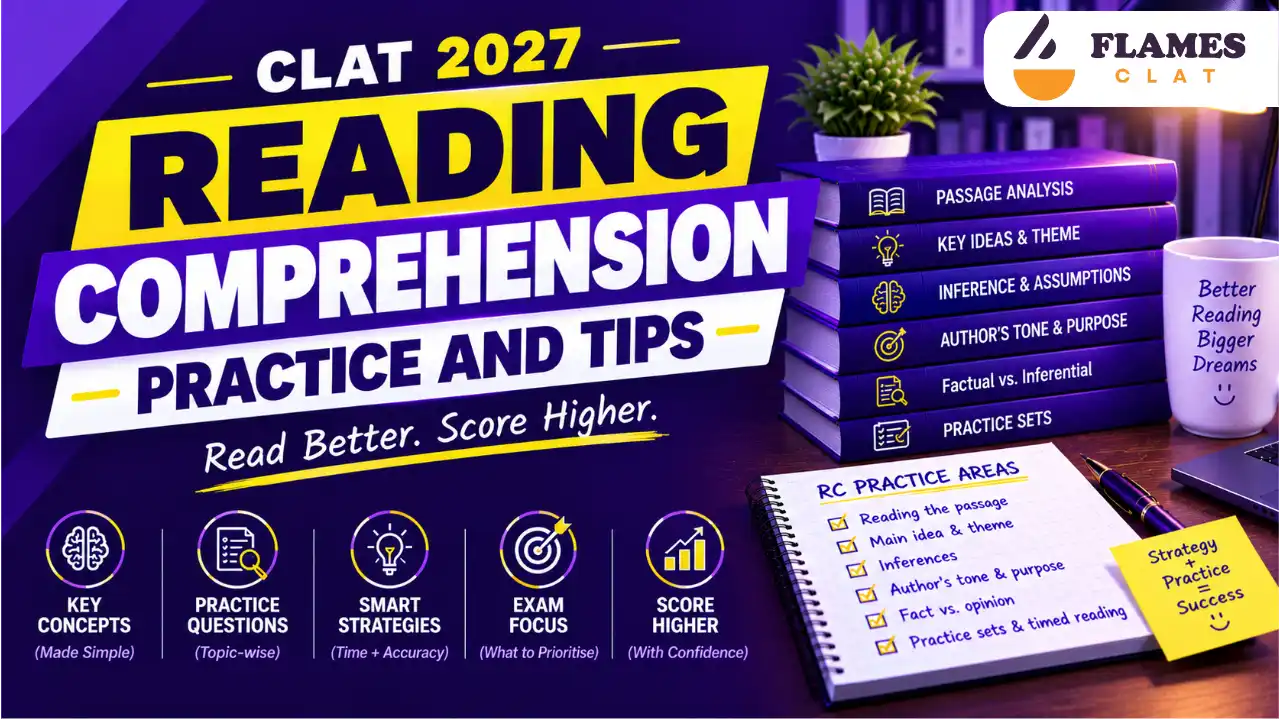
Reading Comprehension is an important part of CLAT 2027 preparation. It tests more than your ability to read a passage; it evaluates how well you understand the author's ideas, identify the main argument, interpret information, and draw conclusions from the text. Even when a passage seems easy to understand, choosing the correct answer can be challenging if you overlook a key detail or misinterpret the author's point of view.
The good news is that Reading Comprehension can improve with regular practice and the right approach. Instead of reading faster just to save time, focus on understanding passages efficiently and answering questions with confidence.
1. Read for Meaning, Not Just Speed
One of the most common mistakes students make is rushing through a passage without understanding its central idea. You may finish reading quickly, but if you cannot recall the author's argument, you might have to reread the passage several times.
While reading, focus on the main idea, the author's purpose, and how different paragraphs connect. You do not need to memorise every sentence. Instead, develop a clear understanding of what the passage is trying to communicate.
2. Identify the Main Idea and the Author's Tone
CLAT passages may discuss social issues, economics, technology, history, philosophy, or other subjects. Your task is to understand the passage rather than become an expert on its topic.
Pay attention to the author's tone. Is the author critical, supportive, neutral, concerned, or optimistic? Identifying the tone can help you answer questions about the author's attitude, purpose, and central argument.
Also, distinguish between the author's own views and the opinions of people or experts mentioned in the passage.
3. Practise Inference-Based Questions
Not every answer will be stated directly in the passage. Some questions require you to draw a reasonable conclusion from the information provided.
For inference questions, select an option that is supported by the text, even if the exact words do not appear in it. Avoid choosing answers based on personal beliefs, outside knowledge, or assumptions that the author has not established.
Tip: Ask yourself, “Can I justify this answer using the passage?” If you cannot, reconsider your choice.
4. Improve Your Vocabulary Through Context
You may encounter unfamiliar words while reading CLAT passages. Instead of stopping every time you see a difficult word, try to understand its meaning from the surrounding sentences.
Pay attention to how the word is used and how it relates to the overall argument. Reading editorials, essays, and quality non-fiction regularly can help you become more comfortable with different writing styles and vocabulary.
The aim is not to memorise endless word lists but to improve your ability to understand unfamiliar language in context.
5. Learn to Eliminate Incorrect Options
Sometimes, two or more options may seem plausible. The key is to identify which option is most strongly supported by the passage.
- Eliminate options that contradict the text.
- Avoid options that introduce information not supported by the passage.
- Be cautious of extreme statements such as “always,” “never,” and “only” when the author has not made such absolute claims.
- Check whether the option answers the actual question rather than a related issue.
Remember, an answer may sound reasonable in real life and still be incorrect if the passage does not support it.
6. Balance Reading Speed and Accuracy
Time management is important, but reading quickly without understanding can lead to unnecessary mistakes. Start by practising passages at a comfortable pace and focus on accuracy.
As your comprehension improves, gradually introduce time limits. Track how long you spend reading each passage and answering its questions. Over time, this will help you identify whether you need to improve your reading pace, understanding, or decision-making.
Do not compare your speed with someone else's. Focus on developing a method that helps you read efficiently while maintaining accuracy.
7. Review Every Practice Session
Practising passages is useful, but reviewing your answers is what helps you understand your weaknesses.
After each session, examine the questions you answered incorrectly. Did you misunderstand the passage, miss an important detail, misinterpret the author's tone, or choose an option based on outside knowledge?
Keep track of recurring mistakes and practise similar questions. You should also revisit questions you answered correctly through guesswork, because understanding why an answer is correct is more valuable than getting it right by chance.
Reading Comprehension improves when you develop the habit of reading actively, identifying the main argument, understanding the author's tone, and evaluating options against the passage. You do not need to know everything about a topic to answer questions correctly. You need to read carefully, think critically, and practise consistently.
Read → Understand → Analyse → Eliminate → Review → Improve
Stay connected with FLAMES CLAT for more CLAT preparation resources, practice opportunities, and updates:
- Telegram: https://t.me/WH6RLT10jpAmH3XR
- YouTube: https://www.youtube.com/@flamesclat
- Website: https://www.flamesclat.com
- Monthly Quiz: https://www.flamesclat.com/monthly-quiz
Keep reading, keep practising, and take one step closer to your CLAT 2027 goal with FLAMES CLAT!