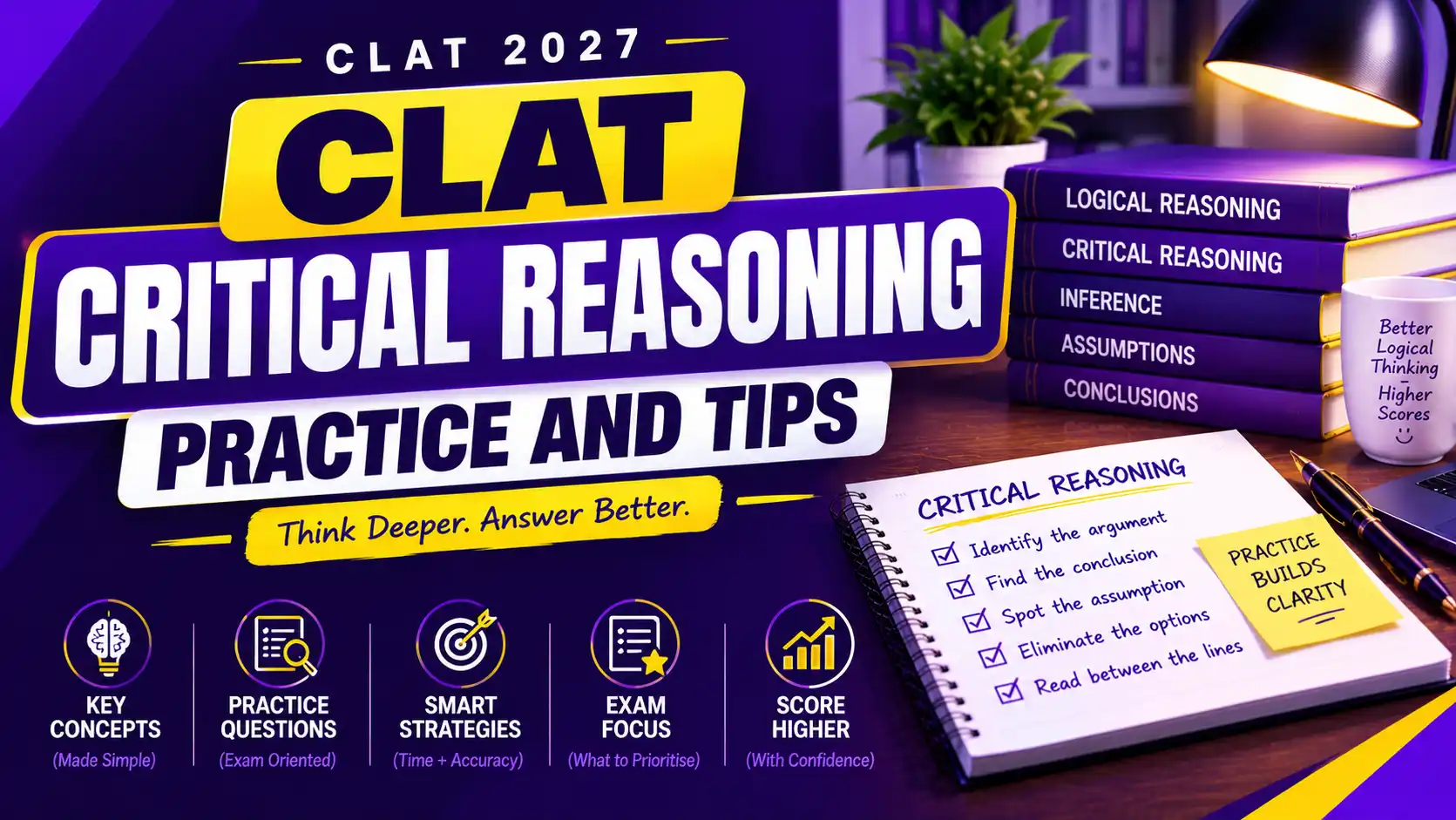
Critical Reasoning is an important part of CLAT preparation, but it is also a section where many students lose marks because they focus on what sounds correct rather than what the passage actually supports. The key is to understand the argument, identify the author's conclusion, and evaluate the logic behind it.
If you want to improve your Critical Reasoning skills, you need more than just solving questions. You need to understand why an answer is correct and why the other options are wrong.
1. Understand the Argument Before Choosing an Answer
Every argument has a basic structure: a conclusion supported by reasons or evidence. Your first task is to identify what the author is trying to establish and which statements support that point.
For example, if a passage argues that public transport should be improved to reduce traffic congestion, the conclusion is that public transport needs improvement. The reasons given in the passage explain why the author believes this.
Once you recognise this structure, questions become easier to approach.
2. Learn to Identify Assumptions
Assumptions are ideas that an argument depends on but does not explicitly state. Questions on assumptions test whether you can recognise what must be true for the author's reasoning to work.
While solving these questions, ask yourself: What is the author taking for granted? Avoid choosing an option simply because it sounds reasonable. The correct answer must have a clear connection to the argument.
3. Practise Strengthening and Weakening Arguments
Strengthening questions ask you to identify information that makes an argument more convincing. Weakening questions require you to find information that challenges the reasoning or reduces the strength of the conclusion.
For these questions, focus on the relationship between the evidence and the conclusion. An option may introduce a relevant fact, but it is useful only if that fact actually affects the argument.
4. Do Not Ignore the Author's Point of View
Critical Reasoning passages may discuss social issues, government policies, economics, education, or other unfamiliar topics. You do not need to be an expert on every subject.
Your job is to understand the argument presented in the passage, not to replace it with your personal opinion or outside knowledge. Always return to the text before selecting an answer.
5. Eliminate Options Carefully
Sometimes, two options may appear correct at first glance. This is where careful elimination becomes important.
- Remove options that are irrelevant to the argument.
- Be cautious of extreme words such as always, never, and only when the passage does not support such certainty.
- Reject options that introduce assumptions unsupported by the text.
- Choose he option that answers the exact question being asked.
Remember, an option can be factually true and still be the wrong answer.
6. Practise Regularly, but Analyse Your Mistakes
Solving multiple questions is useful, but simply counting how many questions you attempted will not necessarily improve your performance. After every practice session, review your mistakes.
Ask yourself whether you misunderstood the conclusion, missed an assumption, misread the question, or selected an option based on personal opinion. Identifying the reason behind each mistake helps you avoid repeating it.
You should also practise under timed conditions as your accuracy improves. This helps you develop both logical clarity and time management.
7. Build a Smart Critical Reasoning Routine
You can make your practice more effective by following a simple routine:
- Read the passage carefully.
- Identify the conclusion and supporting reasons.
- Understand what the question requires.
- Evaluate each option against the argument.
- Review the answer and understand the reasoning behind it.
Consistency matters more than completing a large number of questions without reviewing them.
Critical Reasoning is a skill that develops with deliberate practice. You do not need to understand every topic in a passage; you need to understand how the argument works. Focus on logic, practise different question types, and learn from every incorrect answer.
Stay connected with FLAMES CLAT for more preparation resources, practice opportunities, and updates:
- Telegram: https://t.me/WH6RLT10jpAmH3XR
- YouTube: https://www.youtube.com/@flamesclat
- Website: https://www.flamesclat.com
- Monthly Quiz: https://www.flamesclat.com/monthly-quiz
Keep practising, stay consistent, and make every question an opportunity to improve your CLAT preparation!