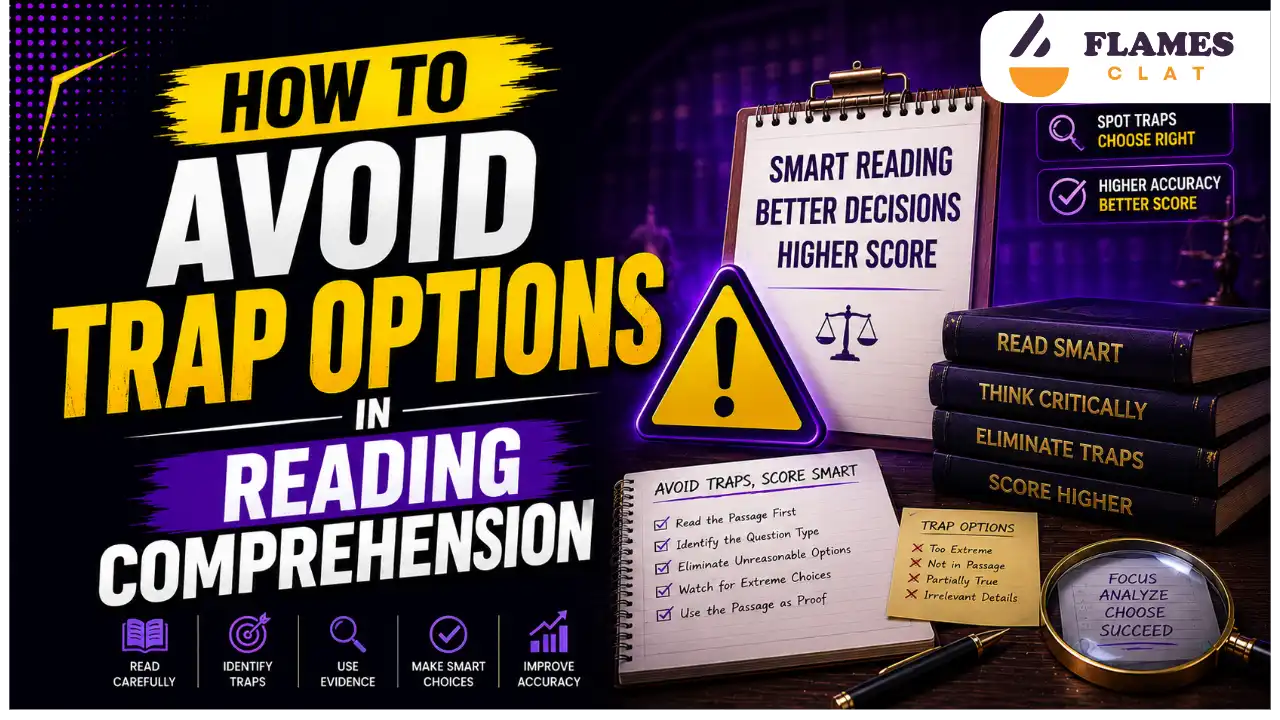
Reading Comprehension in CLAT is not simply about reading a passage and finding the answer that sounds right. Many students understand the passage correctly but still lose marks because they fall for trap options—choices that look convincing, use familiar words, or appear to match the passage but are ultimately incorrect.
The good news is that these options are not random. They usually follow certain patterns. Once you learn to recognise them, you can become much more accurate while solving Reading Comprehension questions.
Read the Passage for Meaning, Not Just Information
One of the biggest mistakes students make is reading a passage simply to remember its details. Instead, try to understand the central argument, tone, purpose, and relationship between ideas. Ask yourself: What is the author really trying to say? Is the author supporting an idea, criticising it, comparing two viewpoints, or presenting multiple perspectives? When you understand the overall argument, it becomes much easier to reject an option that may contain a few correct facts but does not represent the passage as a whole.
Watch Out for Options That Are Too Extreme
Trap options often use strong words such as "always," "never," "completely," "only," "all," or "none." For example, if a passage says that a particular policy may create certain difficulties, an option stating that the policy "will always fail" is probably going beyond what the passage supports. This doesn't mean every option containing a strong word is automatically wrong. The important thing is to check whether the passage actually supports that level of certainty.
Don't Choose an Option Just Because It Uses the Passage's Words
This is one of the most common traps. An option may repeat words or phrases directly from the passage, making it feel familiar and therefore correct. But familiarity does not equal correctness. The question is not asking, "Which option sounds like the passage?" It is asking, "Which option correctly answers the question based on the passage?"
Always look at the meaning of the statement and the context in which the information was presented.
Beware of Half-True Options
Some of the most dangerous options are not completely wrong. They contain information that is mentioned in the passage but fail to answer the actual question. Suppose a question asks about the author's primary argument, and one option mentions a minor example discussed in the passage. That option may be factually correct, but it still isn't the best answer. This is why you should distinguish between "true according to the passage" and "the best answer to the question."
Don't Bring Outside Knowledge Into the Question
CLAT Reading Comprehension questions are generally designed to be answered using the information and reasoning provided in the passage. Sometimes you may already know something about the topic. That's useful for understanding the context, but it can also become a trap. If an option seems correct because of something you know from outside the passage, stop and ask:
"Can I justify this answer using the passage?"
If you cannot, reconsider it.
Pay Attention to the Question
Students often focus so heavily on the passage that they don't read the question carefully enough. Words such as "primarily," "most likely," "according to the passage," "best explains," and "can be inferred" can completely change what the question is asking.
Before looking at the options, make sure you understand exactly what you need to find.
Use Elimination Instead of Guessing
When you're unsure between two options, don't immediately choose the one that feels better.
Eliminate options systematically.
Ask:
- Is this directly contradicted by the passage?
- Is it too broad or too narrow?
- Does it introduce an idea that the author never discussed?
- Does it answer the question being asked?
- Is the conclusion stronger than what the passage supports?
Once you eliminate the weaker choices, the correct answer often becomes much clearer.
Practice Recognising Your Own Traps
Every student has a different pattern of mistakes. Some students consistently choose extreme options. Others are attracted to familiar words or change their answers unnecessarily. This is where mock-test analysis becomes important. After every mock, don't just record which Reading Comprehension questions you got wrong. Record why you got them wrong. Over time, you'll notice patterns in your mistakes and become much better at recognising the traps before they cost you marks.
Final Thoughts
Trap options are designed to make you doubt yourself, but they become much easier to handle once you know what to look for.Don't choose an option simply because it sounds intelligent, contains words from the passage, or feels familiar. Choose the option that is most directly and accurately supported by the passage and answers the question being asked.
The key to improving Reading Comprehension is not reading faster and guessing quicker. It is reading carefully, thinking critically, and eliminating options logically.
With consistent practice, you'll start recognising trap options almost automatically and those small improvements in accuracy can make a significant difference to your CLAT score.
Prepare Smarter with FLAMES CLAT
📝 Attempt our FREE Monthly CLAT Quiz:
https://www.flamesclat.com/monthly-quiz
▶️ Watch expert preparation strategies:
https://www.youtube.com/@flamesclat
📲 Join our Telegram Community:
Read carefully. Think critically. Choose confidently. Prepare for CLAT 2027 with FLAMES CLAT.