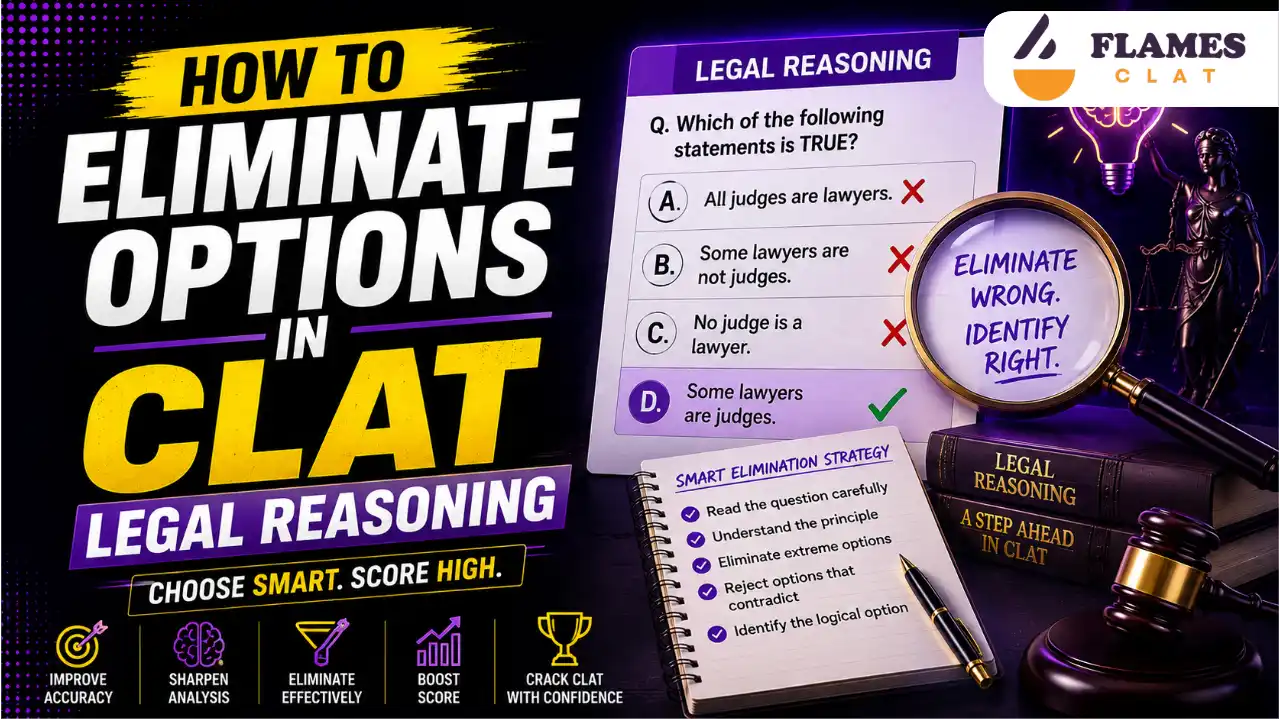
CLAT Legal Reasoning is not always about immediately knowing the correct answer. In many questions, you may find yourself stuck between two or three options that all seem reasonable. This is where option elimination becomes one of the most useful skills. Instead of trying to identify the perfect answer instantly, you can often reach the right answer by systematically removing the options that do not properly apply the principle given in the passage.
Start With the Principle
Before looking closely at the options, make sure you understand the legal principle or rule given in the passage. Ask yourself what the rule actually says and what conditions need to be satisfied for it to apply. Don't change the principle in your head or add exceptions that aren't mentioned. The options have to be tested against the rule provided in the question.
Look at What the Question Is Actually Asking
Sometimes students eliminate an option because they think it is legally incorrect, when the question is actually asking something slightly different. Pay attention to words such as “most appropriate,” “correct,” “cannot,” “except,” “best explains,” or “most likely.” A single word can change what you're looking for. Before comparing the options, identify the exact task.
Eliminate Options That Add Facts
One of the biggest traps in Legal Reasoning is an option that introduces something that was never given in the facts. Suppose the passage tells you that A entered B's property without permission. If an option assumes that A had already been warned several times, that additional fact cannot simply be treated as true. Stay within the information provided.
Don't solve the question using facts that exist only in your imagination.
Look for Options That Misapply the Principle
An option may sound legally sophisticated but still be wrong because it applies the principle incorrectly. Don't be impressed by complicated legal language. Ask a simpler question:
“Does this option actually follow from the rule given in the passage?”
If the principle requires certain conditions and the option ignores one of those conditions, you can eliminate it.
Be Careful With Absolute Statements
Options containing words such as “always,” “never,” “only,” “in every case,” or “under no circumstances” deserve extra attention.
These statements are not automatically wrong, but they make a very broad claim. If the principle does not support such an absolute conclusion, the option is likely a trap. Compare the exact strength of the principle with the strength of the option.
Don't Choose What Feels Morally Right
This is one of the most common mistakes in Legal Reasoning. You may read a situation and immediately think, “But that's unfair.” However, CLAT is testing whether you can apply the given legal principle, not whether you personally agree with the outcome.
An answer can feel unfair and still be legally correct under the principle provided.
When Two Options Look Correct
This is where elimination becomes especially useful.
Don't ask, “Which one sounds better?” Instead, compare the two options directly with the principle. Which one applies all the necessary conditions? Which one relies on an assumption? Which one goes beyond the facts? Which one answers the question more precisely? Usually, one option will have a small but important flaw.
Use the Passage as Your Evidence
Your answer should be traceable back to the passage.
If you cannot explain which part of the principle or facts supports your chosen option, pause before selecting it. A good habit is to mentally complete this sentence:
“I am choosing this option because the principle says ___, and the facts show ___.”
If you can make that connection clearly, your answer is much more likely to be reliable.
Don't Overthink After Eliminating the Wrong Options
Once you've confidently eliminated the clearly incorrect choices, don't create unnecessary doubts. If two options remain, compare them carefully. But once one option has stronger support from the principle and facts, move forward. Remember that CLAT rewards sound decision-making under time pressure, not endless analysis of every possibility.
Practise Elimination During Mocks
Option elimination is a skill that improves with practice. When analysing your mocks, don't just check whether your answer was correct. Look at the options you eliminated and ask yourself why they were wrong. Over time, you'll start recognising recurring traps—irrelevant facts, extreme statements, assumptions, partial application of the principle, and answers based on outside knowledge.
You don't always need to know the correct answer immediately. Sometimes the easiest route is to prove why three options are wrong.
Read the principle carefully, understand what the question is asking, stay within the given facts, watch out for extreme statements and assumptions, and choose the option that most accurately applies the rule. In CLAT Legal Reasoning, the right answer isn't always the option that sounds the most convincing. It's the option that survives the principle, the facts, and the process of elimination.
Prepare Smarter with FLAMES CLAT
At FLAMES CLAT, we believe that strong Legal Reasoning comes from learning how to read, apply, eliminate, and decide—not simply memorising laws.
📝 Take the FREE FLAMES CLAT Monthly Quiz:
https://www.flamesclat.com/monthly-quiz
▶️Watch FLAMES CLAT on YouTube:
https://www.youtube.com/@flamesclat
📲 Join the FLAMES CLAT Telegram Community:
https://t.me/WH6RLT10jpAmH3XR
Read the rule. Test the facts. Eliminate smartly. Choose confidently.