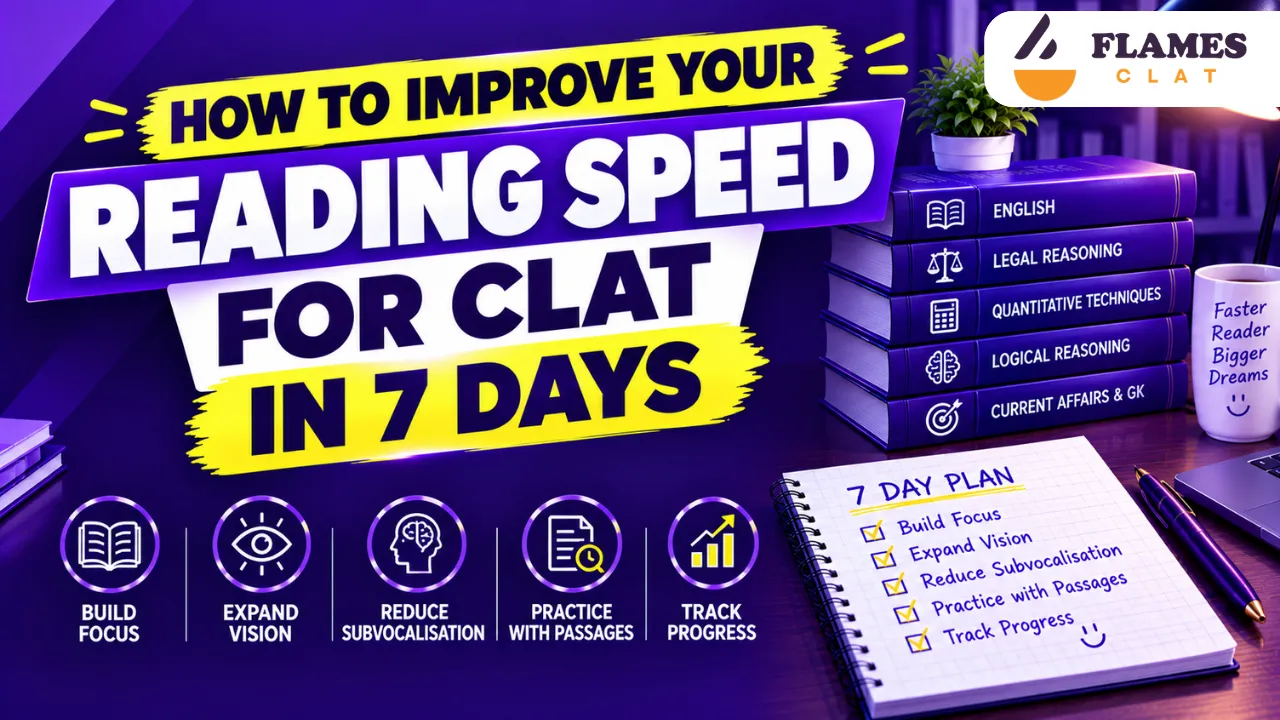
Reading speed plays an important role in CLAT preparation. Since the exam involves passage-based questions across multiple sections, aspirants need to read, understand, and analyse information within a limited time. Reading too slowly can leave you rushing through questions, while reading too quickly can lead to mistakes.
The goal is not simply to read faster. It is to improve your reading speed without compromising comprehension and accuracy.
If you are preparing for CLAT 2027, here is a practical seven-day plan to help you improve your reading skills.
Day 1: Understand Your Current Reading Speed
Before trying to improve your speed, identify your starting point.
Choose a passage similar in length and difficulty to those used in CLAT practice. Record how long you take to read it and answer the related questions.
Pay attention to whether you struggle with unfamiliar vocabulary, lengthy sentences, or understanding the main argument. This will help you identify what needs improvement.
Day 2: Practise Reading Without Losing Focus
Many students read a passage multiple times because they lose focus or fail to understand its structure.
Practise reading short editorials or other well-written passages without unnecessary interruptions. After reading, summarise the main idea in two or three sentences.
This exercise trains you to identify the central message rather than getting stuck on every sentence.
Day 3: Learn to Identify the Main Idea
CLAT passages often require you to understand an author's argument, tone, purpose, or conclusion.
While reading, ask yourself:
- What is the passage mainly about?
- What is the author trying to communicate?
- Which arguments or examples support the main idea?
- What conclusion can be drawn from the passage?
Recognising the structure of a passage helps you process information more efficiently.
Day 4: Expand Your Vocabulary Through Context
Unfamiliar words can slow you down, but stopping to look up every word interrupts your reading flow.
Instead, try to understand unfamiliar words from the surrounding sentences. After completing the passage, note down important words and revise their meanings.
Over time, this can help you read more smoothly and understand complex passages with greater confidence.
Day 5: Practise Timed Reading Comprehension
Now begin practising with a timer.
Attempt reading comprehension passages and answer their questions within a reasonable time limit. Check both your speed and your accuracy.
If you finish quickly but answer many questions incorrectly, slow down and focus on comprehension. If your answers are accurate but you take too long, practise identifying key information more efficiently.
The objective is to find a balance between speed and accuracy.
Day 6: Practise Across Different CLAT Sections
Reading skills are useful beyond the English section. Legal Reasoning and Logical Reasoning also require you to understand arguments, conditions, and information presented in passages.
Practise passages from different sections and notice how your reading approach changes according to the task.
For example, Legal Reasoning requires careful application of principles, while Logical Reasoning often requires identifying arguments and conclusions. Speed should never come at the cost of understanding the information provided.
Day 7: Attempt a Timed Practice Set and Review Your Performance
On the final day, attempt a timed set of passages under exam-like conditions.
Compare your performance with Day 1. Check whether you are reading more efficiently, understanding the passages better, and answering questions accurately.
Review every incorrect answer. Determine whether the mistake occurred because you rushed, misunderstood the passage, or made an unsupported inference.
Remember that seven days can help you develop better reading habits, but significant and consistent improvement usually requires continued practice.
Common Mistakes to Avoid
While working on your reading speed, avoid these common mistakes:
- Reading too quickly: Speed without comprehension can increase incorrect answers.
- Rereading every sentence: Return to specific parts of the passage when necessary instead of repeatedly reading everything.
- Ignoring the author's argument: Understanding the central idea is often more useful than remembering every detail.
- Practising only easy passages: Gradually include more challenging passages to build confidence.
- Ignoring mistakes: Review incorrect answers to understand where your reading approach needs improvement.
Improving your reading speed requires focused practice, active reading, and regular timed exercises. You do not need to understand every word instantly. You need to identify the main idea, follow the author's argument, and answer questions accurately.
Read actively → Understand the passage → Practise with a timer → Analyse mistakes → Improve consistently.
For CLAT 2027, focus on building reading habits that help you manage time without sacrificing accuracy.
Stay connected with FLAMES CLAT for preparation resources, practice sessions, and updates.
Website: https://www.flamesclat.com
YouTube: https://www.youtube.com/@flamesclat
Telegram: https://t.me/WH6RLT10jpAmH3XR
Monthly GK Quiz: https://www.flamesclat.com/monthly-quiz