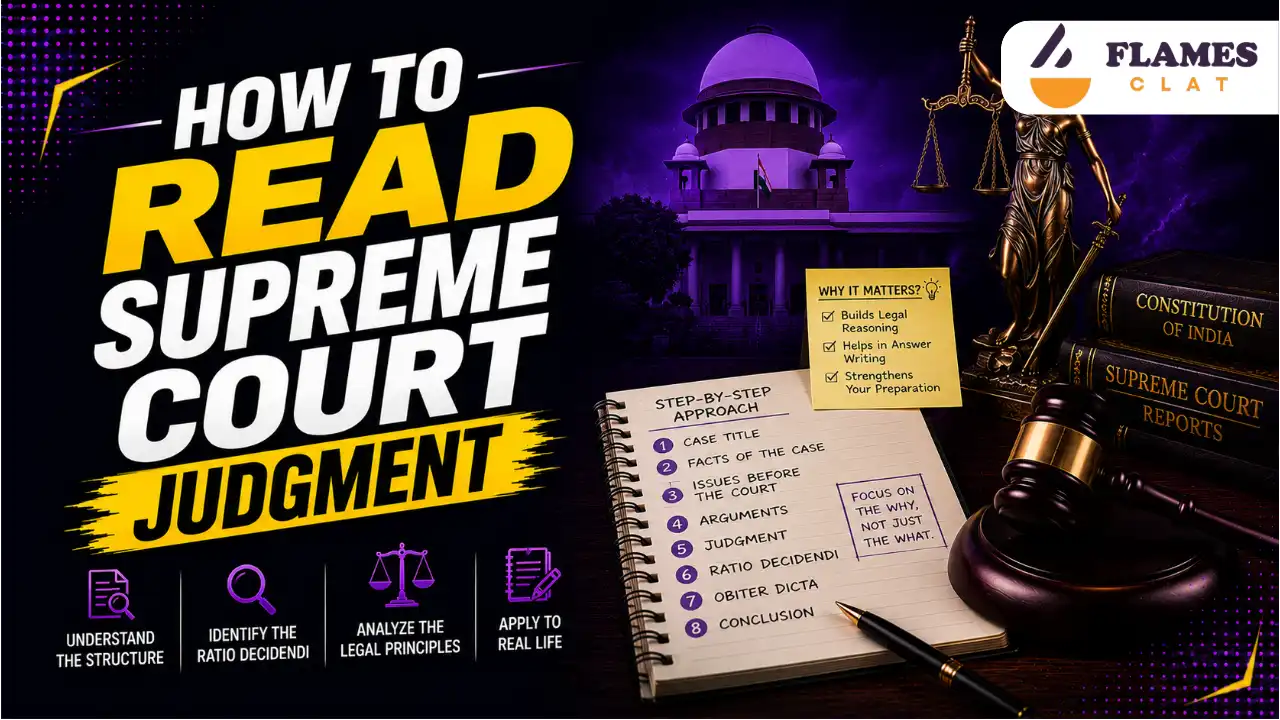
A Supreme Court judgment can look intimidating at first.
There may be dozens of pages, unfamiliar legal terms, multiple judges, references to earlier cases, constitutional provisions, and long arguments from both sides. For a CLAT aspirant, reading a judgment may feel less like learning law and more like trying to decode a different language.
But you do not need to understand every paragraph to understand the case.
The right way to read a Supreme Court judgment is to focus on its structure. Every judgment answers a few basic questions: What happened? What legal issue arose? What did each side argue? What did the Court decide? Why did it decide that way?
Once you learn to identify these parts, judgments become far easier to read.
Start With the Case Name and Basic Details
Before reading the full judgment, look at the case title, court, date, and bench.
For example, a case title such as A v. State of B usually tells you who is challenging whom. The date tells you whether it is a recent decision, while the bench tells you how many judges heard the matter.
For CLAT preparation, you do not need to memorise every judge’s name or procedural detail. Focus on the broad context of the case.
Ask yourself:
- Who are the parties?
- What is the dispute about?
- Is the case related to Fundamental Rights, criminal law, environment, education, privacy, elections, or another issue?
- Is it a recent judgment or a landmark decision?
This gives you a basic map before you begin reading.
Read the Facts Before the Legal Arguments
The facts explain why the case reached the Court.
A judgment may involve a government order, an arrest, a dispute between private parties, a policy decision, a constitutional challenge, or an alleged violation of rights. If you do not understand the facts, the legal reasoning will feel confusing.
While reading facts, identify:
- What happened?
- Who took action?
- Who was affected?
- What was challenged before the Court?
- What relief did the petitioner seek?
Try to explain the facts in two or three simple sentences. If you can do that, you have understood the foundation of the case.
Identify the Legal Issue
The legal issue is the question the Court has to decide.
For example, the issue may be whether a government action violates Article 14, whether a person’s privacy has been infringed, whether a law is constitutional, or whether a particular procedure is legally valid.
A legal issue is often written in formal language. Convert it into a simple question.
Instead of reading: “Whether the impugned notification is violative of Article 19(1)(a) of the Constitution,” think: “Did this government notification unfairly restrict freedom of speech?”
This habit is useful for CLAT Legal Reasoning because it trains you to convert complex language into a clear legal question.
Understand the Arguments of Both Sides
A Supreme Court judgment usually records arguments from both parties.
One side may argue that a law violates Fundamental Rights. The other side may argue that the law is necessary for public interest, security, order, or administration.
You do not need to memorise every argument. Focus on the strongest point from each side.
Ask:
- What does the petitioner want?
- Why does the petitioner believe the action or law is wrong?
- What is the State or opposite party’s defence?
- Which constitutional principle does each side rely on?
Understanding both sides helps you see why the issue is difficult and why the Court’s reasoning matters.
Find the Court’s Reasoning, Not Just the Final Verdict
Many students read only the final result: petition allowed, petition dismissed, law upheld, or law struck down.
But the most important part of a judgment is the reasoning.
The reasoning explains how the Court connected the facts, the law, earlier cases, and constitutional principles to reach its decision.
Look for phrases such as:
- “The Court held that…”
- “It was observed that…”
- “In the present case…”
- “Therefore…”
- “For these reasons…”
- “We are of the view that…”
These lines often contain the core principle of the case.
For CLAT, understanding the principle matters more than remembering the exact wording of the judgment.
Learn the Difference Between Ratio Decidendi and Obiter Dicta
Two legal terms often appear while reading judgments.
Ratio decidendi means the legal reason or principle on which the Court based its decision. It is the binding part of a judgment.
Obiter dicta means observations made by the Court that are not essential to the final decision. These observations may be persuasive but are generally not binding in the same way as the ratio.
For a beginner, the simplest method is to ask: “What rule did the Court need to apply in order to decide this case?” That is usually the ratio.
Read the Final Order Carefully
The final order tells you what the Court actually directed.
The Court may dismiss the petition, allow the appeal, strike down a provision, issue guidelines, grant compensation, remand the matter, or ask another authority to reconsider the issue.
Read this part carefully because it tells you the practical outcome of the case.
However, remember that the final order alone does not explain the full legal principle. Always connect the outcome with the Court’s reasoning.
Make a One-Page Judgment Note
After reading a judgment, make a short note using this format:
Case Name:
Year:
Facts:
Legal Issue:
Arguments:
Decision:
Key Principle:
Why It Matters:
This method helps you revise landmark cases quickly and makes current legal developments easier to understand.
For CLAT aspirants, a one-page note is more useful than copying long paragraphs from the judgment.
Where Should CLAT Aspirants Read Judgments?
CLAT aspirants do not need to begin with lengthy original judgments. Start with short case summaries from reliable legal sources and then read the official judgment when you are comfortable with the topic.
Begin with judgments involving constitutional rights, equality, privacy, freedom of speech, environmental protection, criminal justice, education, and technology. These topics are often relevant to Legal Reasoning and Current Affairs.
As your reading improves, try reading selected portions of the original judgment, especially the facts, issues, reasoning, and final order.
Final Takeaway
Reading Supreme Court judgments is not about understanding every difficult word. It is about understanding the story of the case and the legal principle that came out of it.
Start with the facts. Identify the issue. Understand both sides. Find the Court’s reasoning. Read the final order. Write a short note.
With regular practice, judgments stop feeling overwhelming and start becoming one of the best ways to improve legal awareness, reading comprehension, and CLAT Legal Reasoning.
At FLAMES CLAT, students learn how to simplify legal news, understand landmark judgments, and apply legal principles through passage-based practice and mentor-led discussions.
Follow Flames CLAT - India's Trusted Online CLAT Coaching for more such relevant info!
Test Your Preparation with FLAMES CLAT!
Understanding concepts is only the beginning—consistent practice is what turns preparation into success.
If you're serious about cracking CLAT 2027, put your preparation to the test with our FREE Monthly CLAT Quiz. Curated by experienced mentors, the quiz is designed to help you assess your strengths, identify areas for improvement, and experience questions that reflect the latest CLAT pattern.
📝 Attempt the FREE Monthly CLAT Quiz:
https://www.flamesclat.com/monthly-quiz
At FLAMES CLAT, we're committed to helping every aspirant prepare smarter through expert mentorship, comprehensive study resources, mock tests, current affairs updates, strategy sessions, and daily practice content.
Stay connected with us and take your preparation to the next level:
▶️YouTube: https://www.youtube.com/@flamesclat
📲 Telegram Community: https://t.me/WH6RLT10jpAmH3XR
Your journey to a top National Law University starts with the right guidance and consistent effort. Join the FLAMES CLAT community today and take the next confident step towards achieving your CLAT 2027 dream.