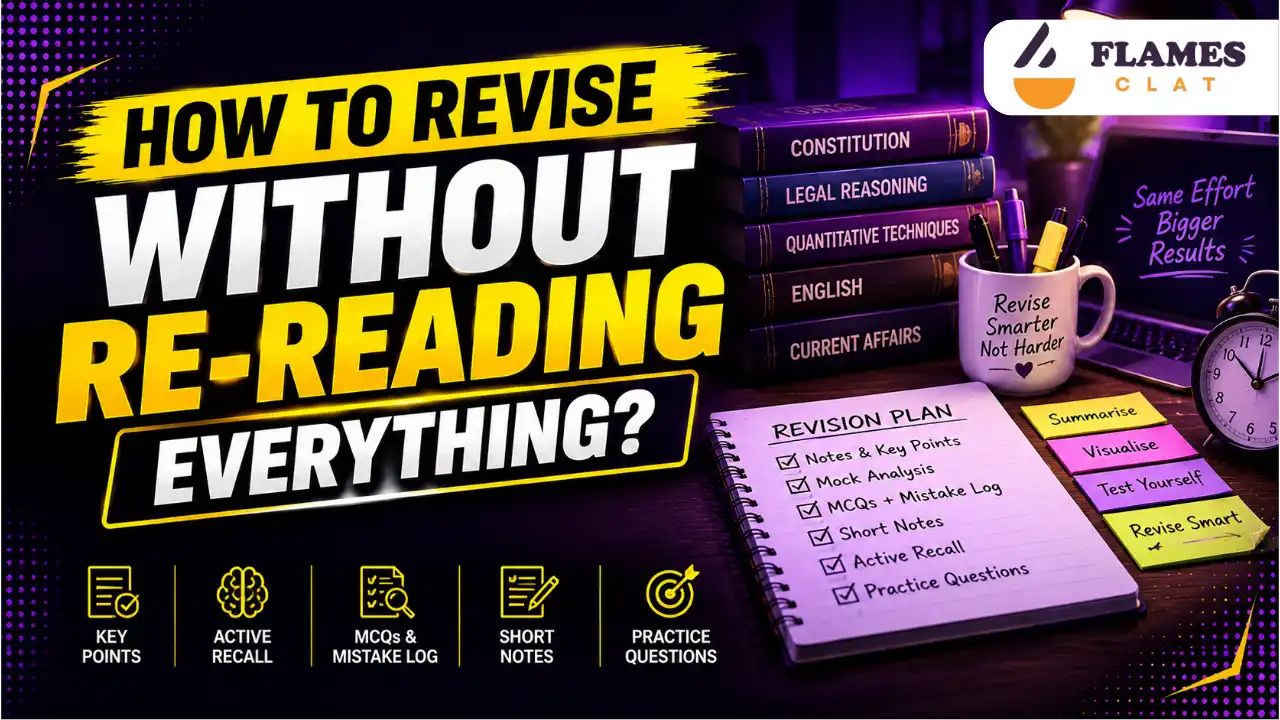
You sit down to revise for CLAT and suddenly realise you have pages of notes, PDFs, current affairs, formulas, and questions to go through. So you start from page one and spend hours reading everything again.
But after a few days, you still don't remember most of it.
The problem isn't that you're not studying enough. You're revising passively. CLAT revision should be about recalling, testing, and fixing what you don't know — not reading the same material repeatedly.
Start With What You Don't Remember
Don't revise everything equally.
Before opening your notes, try to recall what you already know about a topic. Then focus your revision time on the areas where you hesitate, forget information, or repeatedly make mistakes.
Your revision should answer one question:
“What do I still need to remember?”
Use Short Revision Notes
Your notes should become shorter as the exam gets closer.
Instead of revising an entire chapter or a long PDF, create one-page summaries, key facts, formulas, important concepts, and mistake lists that you can quickly revisit.
For GK and Current Affairs especially, avoid making massive notes. Focus on important facts, context, names, dates, organisations, and connections that you are likely to be tested on.
Test Yourself Instead of Just Reading
Close your notes and try to recall the information.
Ask yourself questions, solve a few practice questions, write down important facts from memory, or explain a concept without looking at your notes.
If you cannot recall something, then go back and revise it.
This makes your revision much more active and helps you identify genuine gaps.
Revise Your Mistakes
Your mock and sectional test mistakes are already telling you what needs revision.
Maintain a simple mistake log and regularly revisit questions you got wrong, guessed, took too long to solve, or changed from correct to incorrect.
Instead of revising everything again, you're revising the exact areas that are costing you marks.
Use Spaced Revision
Don't study a topic once and leave it until the exam.
Come back to important topics at increasing intervals — for example, after a few days, then the following week, and again later.
Each revision becomes shorter because you're strengthening what you've already learnt rather than starting from zero.
Mix Revision With Practice
Revision and practice should not be completely separate.
After revising a topic, solve a small set of questions based on it. This helps you check whether you can actually apply what you've revised.
For example:
Revise concept → Solve questions → Check mistakes → Revisit weak area.
This is much more effective than spending hours rereading notes.
Don't Turn Revision Into Procrastination
Sometimes rereading feels productive because you're constantly doing something. But if you already know the material, reading it for the fifth time isn't necessarily helping.
Your goal is not to finish your notes again.
Your goal is to remember more, solve faster, and make fewer mistakes.
Make Your Revision More Targeted
A structured approach can make revision much easier, especially when you're trying to balance multiple CLAT sections.
The FLAMES CLAT Score Booster Series provides subject-wise preparation through topic tests, sectional tests, mocks, live classes, mentorship, and doubt resolution. This allows you to revise and practise specific areas instead of repeatedly going through the entire syllabus without knowing what actually needs improvement.
Final Takeaway
You don't need to reread everything to revise effectively.
Recall → Test → Identify gaps → Revise weak areas → Practise → Repeat.
The closer you get to CLAT, the more your revision should become shorter, targeted, and practice-based.
Don't revise everything. Revise what you need to improve.
For more CLAT preparation resources, check out FLAMES CLAT, attempt the Free Monthly Quiz, and follow FLAMES for regular preparation content.
FLAMES CLAT: https://www.flamesclat.com/
Free Monthly Quiz: https://www.flamesclat.com/monthly-quiz
YouTube: https://www.youtube.com/@flamesclat
Telegram: https://t.me/WH6RLT10jpAmH3XR