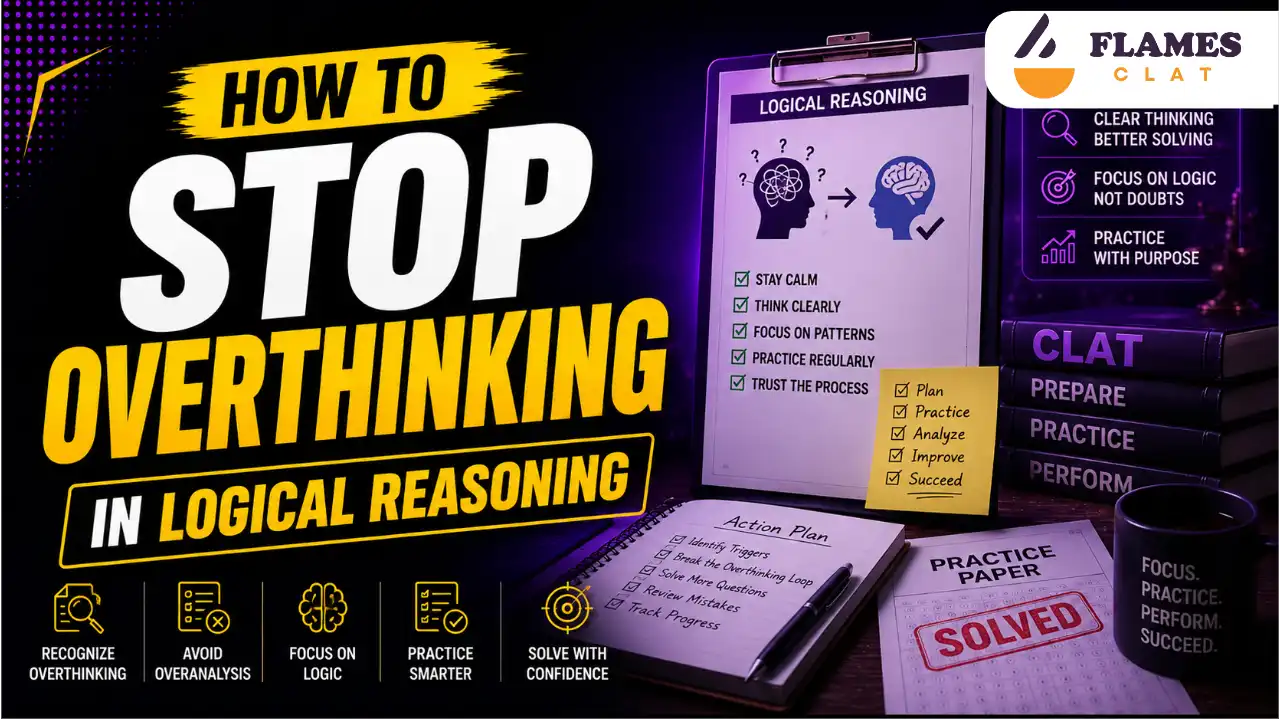
Logical Reasoning is one of the most scoring sections in CLAT, yet it is also the section where many aspirants lose marks unnecessarily. Surprisingly, the problem is often not a lack of knowledge or reasoning ability it is overthinking.
Have you ever solved a question, selected an answer, and then changed it at the last moment, only to realise your first answer was correct? Or have you spent several minutes analysing every option because each one seemed possible? If yes, you're not alone. Overthinking is a common challenge for CLAT aspirants, and it can affect both your accuracy and your time management.
The good news is that overthinking is a habit that can be controlled with the right approach.
One of the biggest reasons students overthink is that they try to use their own opinions while solving Logical Reasoning questions. However, CLAT does not ask what you believe. It asks you to identify the answer that is best supported by the passage. Your personal experiences, assumptions, or opinions should never influence your choice. Every answer must be based on the information provided in the passage and the logic it presents.
Another common mistake is assuming that every question is designed to trick you. While CLAT questions are certainly challenging, they are not impossible. Many students keep searching for hidden meanings or complicated interpretations when the correct answer is actually supported directly by the passage. The more you overcomplicate the question, the more likely you are to move away from the right answer.
Learning the process of elimination can also reduce overthinking significantly. Instead of trying to find the perfect answer immediately, begin by eliminating options that are clearly incorrect or unsupported. Once you've narrowed the choices to two, compare them with the passage carefully. Ask yourself which option is better supported by the information given, not which one sounds more appealing.
Time management plays an important role as well. Spending four or five minutes on a single Logical Reasoning question rarely makes sense in a competitive exam. If a question feels unusually confusing, mark it for review and move on. Returning to it later with a fresh mind often makes the answer much clearer. Remember, every extra minute spent on one difficult question is time taken away from easier questions elsewhere in the paper.
Confidence is another factor that many students overlook. When you have practised enough passages, your first instinct is often based on sound reasoning. Constantly changing answers without a valid reason usually does more harm than good. This doesn't mean your first answer is always correct, but it does mean you should only change it if you discover clear evidence from the passage that proves your initial choice was wrong.
Mock tests are the best place to identify your overthinking habits. After every mock, don't just check which questions you answered incorrectly. Look at the questions where you changed your answer. Ask yourself why you changed it and whether that decision improved your score. Over time, you'll begin to recognise patterns in your decision-making and become more confident during the actual exam.
Finally, remember that Logical Reasoning is not a test of who can think the most—it is a test of who can think clearly and logically. The strongest candidates are not the ones who analyse every possibility endlessly; they are the ones who stay calm, trust the passage, eliminate incorrect options, and make well-reasoned decisions within the available time.
If you find yourself overthinking during practice, pause for a moment and ask yourself a simple question: "Is this answer supported by the passage, or am I adding my own assumptions?" That one question can often bring you back on track.
In CLAT, clarity beats complexity. The more you practise reading carefully, trusting the passage, and avoiding unnecessary assumptions, the more confident and accurate you'll become in Logical Reasoning.
Stay Ahead with FLAMES CLAT!
Improve your Logical Reasoning skills with expert guidance, regular practice, and smart strategies.
📝 Attempt our FREE Monthly CLAT Quiz:
https://www.flamesclat.com/monthly-quiz
▶️ Watch expert strategy videos:
https://www.youtube.com/@flamesclat
📲 Join our Telegram Community for daily quizzes, current affairs, and preparation tips:
At FLAMES CLAT, we help you build the confidence and reasoning skills needed to crack CLAT 2027.