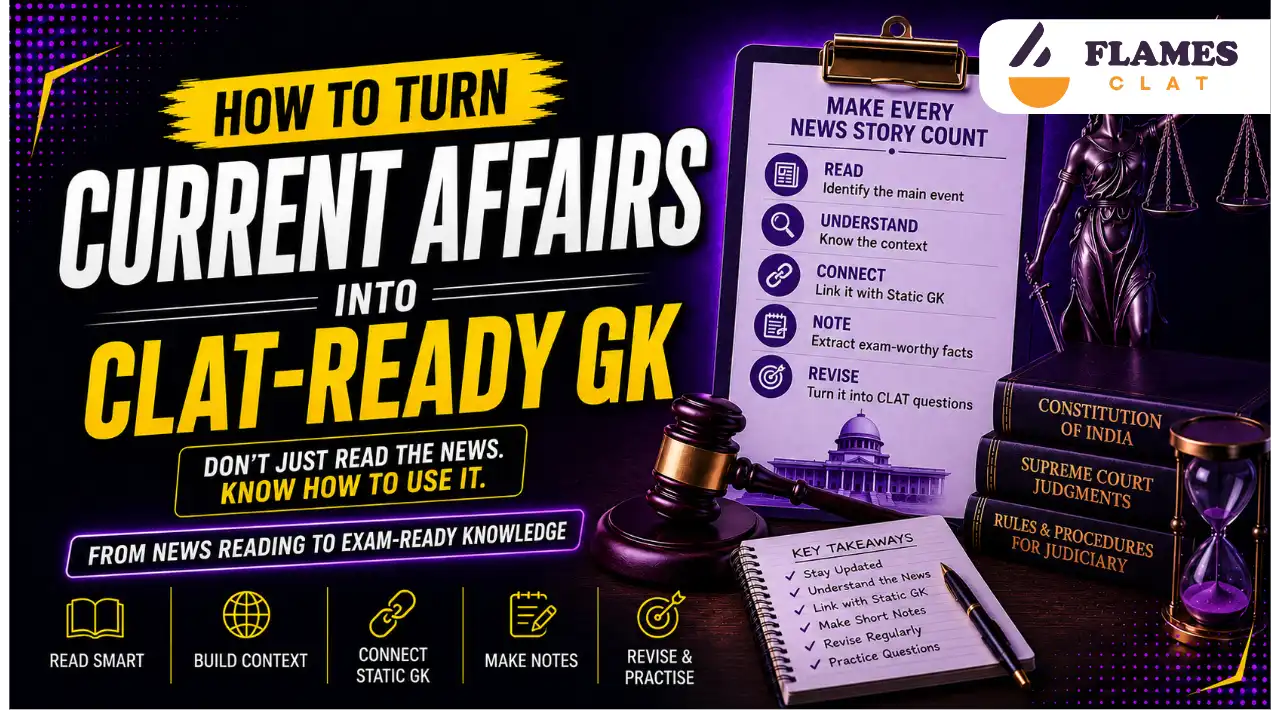
Reading Current Affairs for CLAT is not just about knowing what happened in the news. The real challenge is turning a news event into information that you can understand, remember, and apply in the exam. Many students read newspapers or monthly PDFs regularly but still struggle with GK because they remember the headline but not the context. The key is to stop treating every news story as a collection of random facts and start looking at it as a topic with a story, background, and significance.
Whenever you come across an important current affair, start with four basic questions: What happened? Who was involved? When did it happen? Why does it matter? These four questions give you the core information you need. You don't have to memorise every sentence from the article. Your aim should be to understand the event well enough that, even if CLAT presents it through a passage or asks about it indirectly, you can recognise the context.
The next step is to understand the background behind the event. This is where Current Affairs connects with Static GK. Suppose you read about an important international organisation. Don't just remember the recent development. Know what the organisation does, where it is based, and why it is relevant to the event. Similarly, if you read about a Supreme Court judgment, understand the basic legal issue involved and what the Court decided. You don't need to turn every current affair into a massive Static GK chapter—just learn the background that actually helps you understand the news.
Another important habit is identifying the key facts. For every important current affair, try to reduce it to a few points that you can revise quickly. Depending on the topic, these could include a person's name and position, the organisation involved, an important date, the location, the purpose of an initiative, or the outcome of an event. The goal is not to make your notes longer; it is to make them more useful.
Students also make the mistake of treating every piece of news as equally important. They aren't. A major Supreme Court judgment, a significant government scheme, an important international summit, a major appointment, a landmark report, or a significant national development deserves much more attention than a minor news story that disappears after a day. Learning to prioritise is an important part of GK preparation.
You should also learn to connect related developments. If several news stories are connected to the same issue, studying them together can make them easier to remember. For example, instead of memorising separate facts about an international conflict, understand the broader issue, the countries involved, important organisations, major developments, and their consequences. Once the information forms a story in your head, it becomes much easier to recall.
After studying a current affair, test yourself without looking at your notes. Ask yourself what happened, who was involved, why it was important, and what background information you remember. Then solve MCQs based on the topic. This tells you whether you actually know the information or merely recognise it because you've just read it. Recognition feels like memory, but the exam requires recall.
Your revision should follow the same principle. Don't wait until the last few weeks to revise everything. Revisit important current affairs regularly. During each revision, try to recall the information before looking at your notes. If you remember it easily, move on. If you don't, spend more time on it. This makes revision more efficient and prevents you from repeatedly spending equal time on topics you already know well.
Most importantly, don't fall into the “more sources = better GK” trap. Reading multiple newspapers, websites, PDFs, Telegram channels, and coaching compilations can give you a huge amount of information but very little retention. Pick reliable sources, stay consistent, and spend more time understanding and revising than collecting new material.
A simple way to convert any important news story into CLAT-ready GK is:
NEWS → CONTEXT → KEY FACTS → RELEVANT STATIC GK → MCQs → REVISION
The goal isn't to remember every headline you see. The goal is to understand the important developments well enough that you can recognise their significance and answer questions based on them.
Prepare Smarter with FLAMES CLAT
At FLAMES CLAT, we believe GK preparation is about more than collecting facts. It's about learning how to identify what matters, understand the context, connect it with relevant Static GK, and revise it effectively.
📝 Take the FREE FLAMES CLAT Monthly Quiz:
▶️ Watch FLAMES CLAT on YouTube:
📲 Join the FLAMES CLAT Telegram Community:
FLAMES CLAT Telegram Community
Don't just read the news. Understand it, connect it, and make it CLAT-ready.