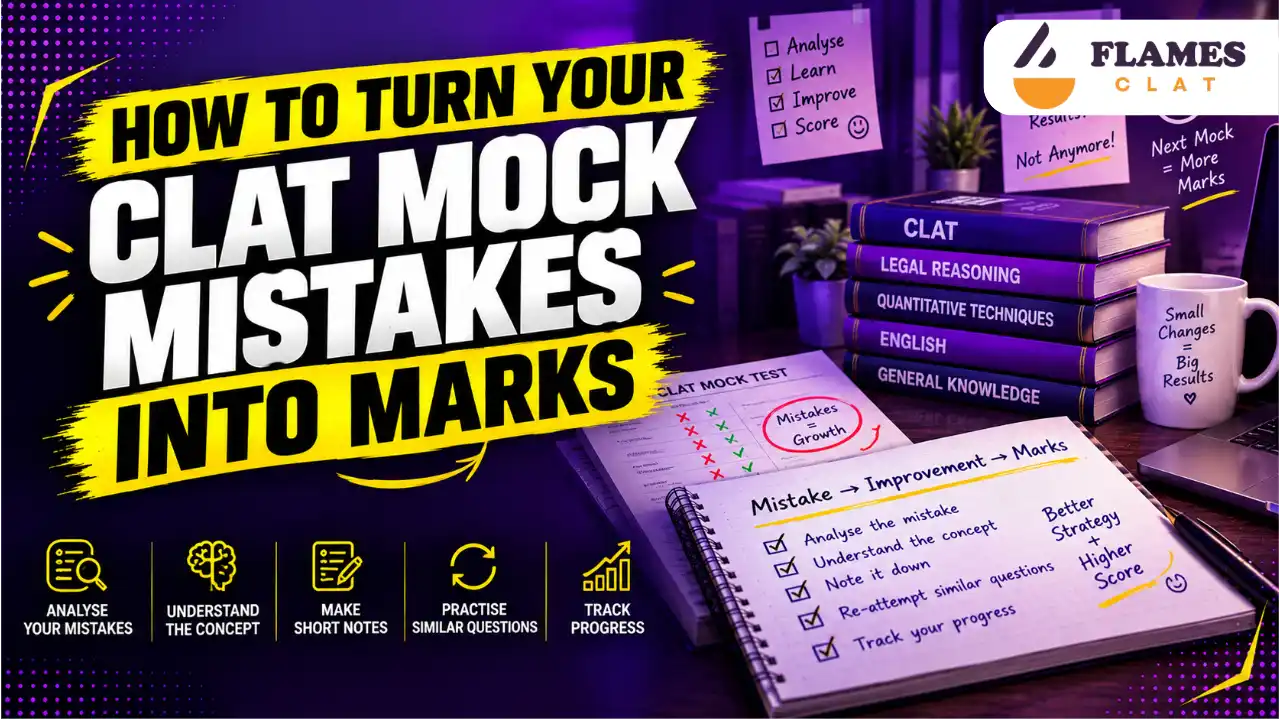
Taking a CLAT mock and checking your score is easy. Actually improving because of that mock is the difficult part. If your mock scores have been stuck, the solution may not be another five mocks. It may be learning how to properly analyse the mistakes you are already making.
Your Mock Score Is More Than a Number
A mock score tells you how many questions you got right and wrong, but it doesn't tell you why. Two students can lose the same number of marks for completely different reasons. One may have a conceptual gap, while another may have rushed through the paper or spent too much time on difficult questions.
That's why your mock should be treated as feedback, not just a test.
Don't Analyse Only the Wrong Answers
One of the biggest mistakes students make is checking only the questions they got wrong.
You should also look at:
- Questions you guessed correctly
- Questions that took too much time
- Questions where you changed the correct answer
- Questions you should have attempted but left
- Questions where you made a silly reading or calculation mistake
These questions can reveal problems that your score alone won't show.
Identify Why You Made the Mistake
Don't simply write:
“Wrong answer – revise.”
Instead, ask yourself what actually went wrong.
Was it a conceptual mistake?
Did you misread the passage or question?
Did you misunderstand the principle?
Did you make a calculation error?
Did you fall for a close option?
Did you spend too much time on the question?
Once you know the reason, you know what needs to change.
Create a Mistake Log
Maintain a simple mistake log after every mock.
You can divide your mistakes into categories such as:
Concept → Reading → Calculation → Option Elimination → Time Management → Guesswork
After a few mocks, look for repetition.
If the same type of mistake keeps appearing, you've found an area that needs immediate attention.
Turn Every Mistake Into a Rule
This is where mistakes actually start becoming marks.
Don't just correct the answer. Create a small rule for yourself.
For example:
Mistake: Chose an option because it sounded logically correct.
New rule: In Legal Reasoning, prioritise the given principle and facts over outside knowledge.
Mistake: Spent four minutes on one Quant question.
New rule: If the calculation isn't progressing, move on and return later.
Mistake: Chose an inference that went beyond the passage.
New rule: Don't add information that the passage doesn't support.
Now your mistake has become a strategy for your next mock.
Reattempt the Questions
After analysing the mock, don't immediately forget the questions.
Return to the questions you got wrong after a few days and try solving them again without looking at the explanation.
If you can now solve them correctly, you've fixed part of the problem.
If you still get them wrong, you know that the underlying issue needs more work.
Track Improvement Across Mocks
Don't compare only your total scores.
Track things like:
Accuracy → Attempts → Time → Section-wise performance → Repeated mistakes
For example, if your score stays similar but your accuracy improves significantly, that's still meaningful progress. It may mean your next focus should be on speed or question selection.
Don't Take Another Mock Immediately
More mocks aren't always the answer.
If you take a mock, check the score for ten minutes, and immediately start another one, you're missing the most valuable part of the process.
Give yourself enough time to analyse, revise, and fix the problems before taking the next full-length test.
Use the Score Booster Approach
This is exactly where structured practice can help.
The FLAMES CLAT Score Booster Series combines mocks, sectional tests, topic-wise tests, live classes till the exams, mentorship, and doubt resolution so that students can work on specific weaknesses instead of simply attempting tests without a plan.
The objective isn't to take a test and move on.
It's to take a test, find the problem, work on it, and perform better the next time.
Final Takeaway
Every CLAT mock contains marks that you haven't scored yet.
Those marks are hidden inside your mistakes, your guesses, your time management issues, and the questions you keep getting wrong.
So don't ask only:
“What did I score?”
Ask:
“Why did I lose these marks—and what am I going to do differently next time?”
Attempt → Analyse → Fix → Reattempt → Improve.
Prepare Smarter with FLAMES CLAT
At FLAMES CLAT, we believe every mock should take you one step closer to your target. The Score Booster Series is designed to help you practise consistently, identify your weak areas, clear your doubts, and improve through structured preparation.
With topic-wise tests, sectional tests, mocks, live classes till the exams, mentorship, and doubt resolution, you can turn your mistakes into a clear plan for improvement.
📝 Take the FREE FLAMES CLAT Monthly Quiz:
FLAMES CLAT Monthly Quiz
▶️ Watch FLAMES CLAT on YouTube:
FLAMES CLAT on YouTube
📲 Join the FLAMES CLAT Telegram Community:
FLAMES CLAT Telegram Community
Your mistakes are not wasted marks—if you learn how to turn them into your next correct answers.