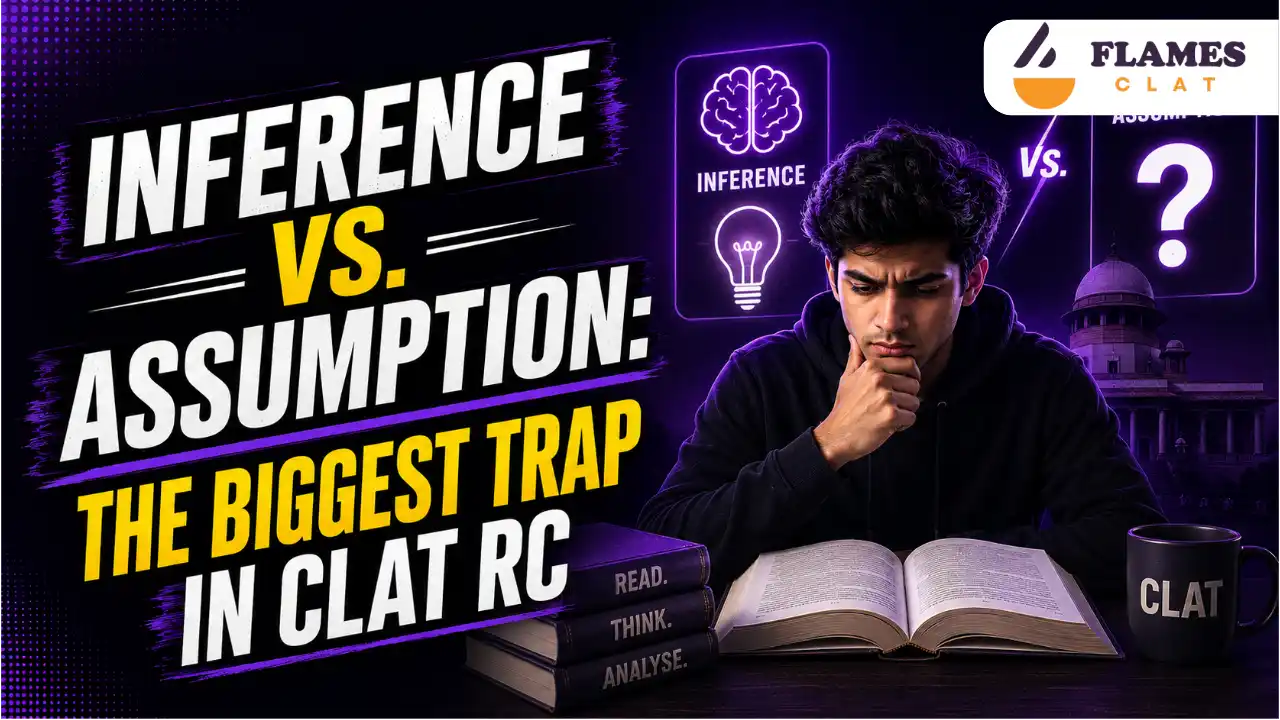
One of the most common reasons students lose marks in CLAT Reading Comprehension is confusing an inference with an assumption. You may understand the passage perfectly, but when two options look equally logical, it becomes easy to choose the one that sounds right instead of the one that is actually supported by the passage. The difference may seem small, but understanding it can significantly improve your RC accuracy.
An inference is a conclusion that can be logically drawn from the information provided in the passage. It may not be directly stated, but the passage gives you enough information to reach that conclusion. For example, if a passage says that a city improved its public transport system and subsequently saw a reduction in traffic congestion, you can infer that improved public transport contributed to reducing congestion. You are connecting the information already provided rather than introducing something completely new.
An assumption, however, is something that you add yourself. It may sound logical or realistic, but the passage does not provide enough evidence to support it. Using the same example, you cannot assume that every person in the city started using public transport unless the passage specifically tells you so. The statement may be possible, but it is not necessarily supported by the passage.
A simple way to remember the difference is: Inference = Passage + Reasoning, while Assumption = Passage + Your Addition. Whenever you're unsure about an option, ask yourself one question: “Can I prove this from the passage?” If you can point to information in the passage and logically connect it to the option, it is likely an inference. If you need to rely on your personal knowledge, beliefs, or what you think is generally true, you may be making an assumption.
This is exactly why CLAT options can be tricky. The incorrect option is often not obviously wrong. It may sound intelligent, reasonable, or even factually correct in real life. But CLAT RC questions are not asking what is generally true. They are asking what can be supported by the passage. An option can therefore be logically possible and still be incorrect if the passage does not provide enough evidence for it.
Students should also be careful with extreme language in answer options. Words such as always, never, everyone, completely, only, must, and in every case can make an option much stronger than what the passage actually establishes. If the passage says that technology can improve access to education, for example, an option saying that technology always improves education goes beyond the passage. The original statement allows a possibility, while the option turns it into an absolute claim.
Another common mistake is bringing personal opinions into the passage. If you are reading about social media, climate change, education, politics, or any other familiar topic, you may already have strong opinions about it. But those opinions should not determine your answer. Your job is to understand the author's argument and identify what the passage actually supports. Even if you disagree with the author, an option supported by the passage can still be the correct answer.
When two options seem correct, don't choose the one that simply sounds more convincing. Go back to the passage and compare both options with the evidence provided. Ask which option can be directly or logically supported and which option requires you to assume something that the author never said. Often, the difference between the two options is just one word or one additional claim.
A useful trick is the “because” test. Take the option and ask yourself, “Why do I think this is correct?” If your answer is, “Because the passage states or suggests this,” you are probably on the right track. But if your reasoning is, “Because this is generally true,” or “Because that would make sense,” be careful. You may be relying on an assumption instead of the passage.
For inference-based questions, follow a simple process: Read → Locate → Connect → Eliminate. First, read the question carefully and understand what it is asking. Then locate the relevant information in the passage. Connect that information logically to the answer option and eliminate choices that introduce unsupported information, exaggerate the author's argument, or depend on assumptions.
You can develop this skill through mock analysis. Don't simply check whether you got an inference question right or wrong. Ask yourself what information in the passage supported your answer, whether you added anything that wasn't mentioned, whether you relied on outside knowledge, and whether you overlooked an extreme word in one of the options. Analysing your reasoning—not just your score—will help you recognise these traps faster.
Ultimately, inference questions test your ability to read between the lines without going beyond them. You are expected to connect ideas and draw reasonable conclusions, but you cannot introduce facts or opinions that the passage doesn't support. The next time you're stuck between two options, don't ask, “Which one sounds right?” Instead, ask, “Which one can I actually prove from the passage?”
That small change in approach can make a significant difference to your CLAT Reading Comprehension accuracy.
Prepare Smarter with FLAMES CLAT
At FLAMES CLAT, we believe strong Reading Comprehension is not just about reading quickly. It is about understanding the author's argument, identifying evidence, making accurate inferences, and avoiding tempting but unsupported options.
Read between the lines. Find the evidence. Don't assume beyond the passage.
📝 Take the FREE FLAMES CLAT Monthly Quiz:
https://www.flamesclat.com/monthly-quiz
▶️Watch FLAMES CLAT on YouTube:
https://www.youtube.com/@flamesclat
📲 Join the FLAMES CLAT Telegram Community:
https://t.me/WH6RLT10jpAmH3XR
Solve smarter. Manage your time. Finish stronger.