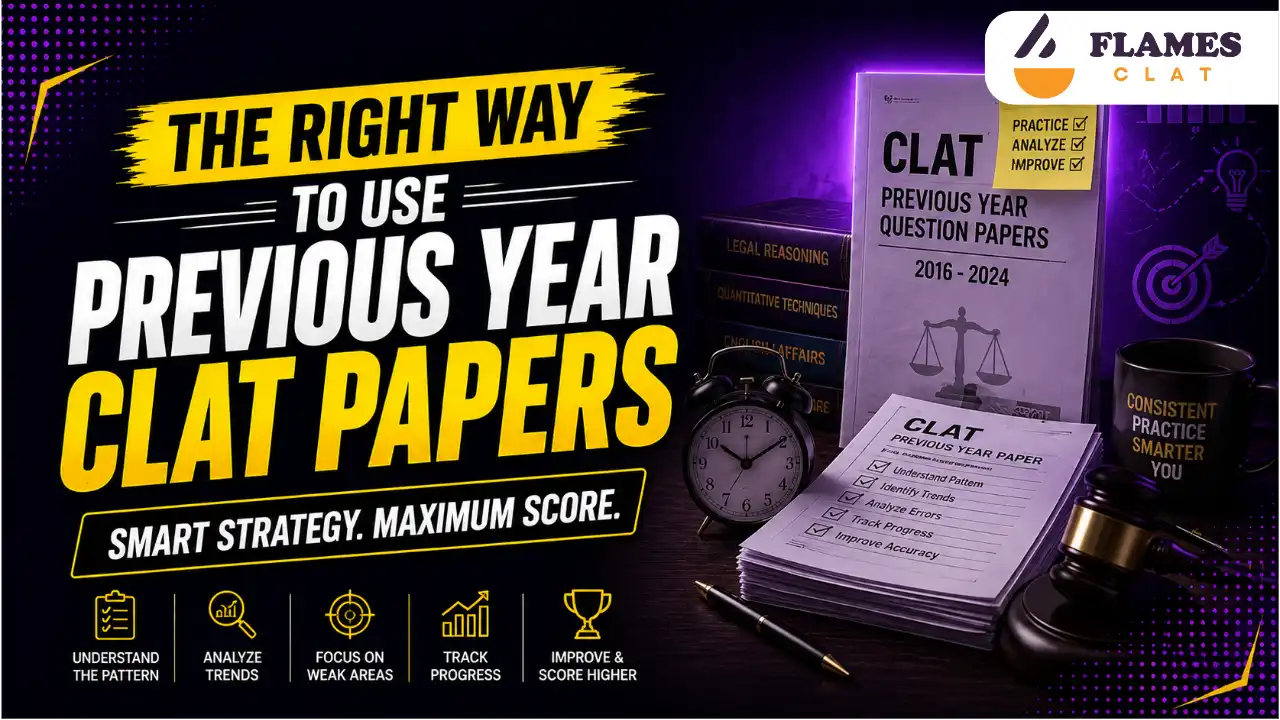
Previous Year Question Papers, or PYQs, are among the most valuable resources for any CLAT aspirant. They give you an opportunity to see the exam from the perspective of someone who has actually set it, rather than simply practising questions created for preparation.
However, many students make the mistake of treating PYQs like just another set of practice questions. They solve a paper, check the answers, calculate their score, and move on. While this is better than not solving them at all, it misses the real value of previous year papers.
The purpose of PYQs is not just to tell you how many questions you can answer. They help you understand how CLAT asks questions, how passages are structured, what kind of reasoning is expected, and how you respond to the actual exam style.
Don't Solve PYQs Just for the Score
When you solve a previous year paper, don't treat the score as the only measure of your performance. A PYQ is not necessarily comparable to a coaching mock because the difficulty, style, and purpose can be different. Instead, pay attention to the questions themselves. Look at how the options are framed, how the passage leads you towards an answer, and how much information you actually need to use.
Ask yourself: What is this question testing?
Once you start thinking this way, PYQs become much more useful.
First Understand the Pattern
Before solving multiple papers, spend some time observing them. Look at the different sections, passage lengths, question types, and the way options are presented. Notice which questions require direct understanding and which require you to infer something from the passage. This gives you a clearer picture of what you're preparing for. Instead of preparing for a vague idea of "CLAT," you're preparing for the kind of thinking the actual examination demands.
Solve Some Papers Like the Real Exam
At least a few PYQs should be attempted under proper exam conditions. Sit down with a timer, avoid distractions, and attempt the paper in one sitting. This helps you understand how you perform when there is continuous time pressure. You may discover that a section you usually perform well in takes longer than expected or that you make more mistakes towards the end of the paper.
The experience is very different from casually solving ten questions at a time.
But Don't Stop at Checking the Answers
This is where the real learning begins.
After completing a PYQ, go back to every incorrect answer and understand why you got it wrong. But don't stop there. Also look at questions where you guessed correctly or reached the right answer after considerable confusion. A correct answer isn't necessarily evidence that you understood the question properly. If you got it right by guessing, you still have something to learn. Your goal should be to know why the correct option is correct and why the other options are not.
Use PYQs to Identify Your Weaknesses
Previous year papers can also help you identify recurring problems in your preparation.
Perhaps you understand the passage but struggle with inference-based questions. Maybe you are comfortable with Legal Reasoning but lose time in Quantitative Techniques. Or perhaps your answers are generally correct, but you change them unnecessarily after overthinking. Make a note of these patterns. Over time, your PYQ analysis should give you a clearer answer to one important question:
"What exactly is stopping me from scoring higher?"
Don't Memorise the Questions
Another common mistake is repeatedly solving the same PYQs until you remember the answers.
That doesn't necessarily mean you've improved.
The objective is to understand the method of thinking behind the question. If you remember that the answer to a particular question is option B but cannot explain why, you haven't gained much from the exercise. Instead, focus on the reasoning, structure, and approach that can be applied to unfamiliar questions.
Use PYQs Alongside Mocks
PYQs and mock tests serve different purposes. Mocks help you practise time management, build stamina, experiment with strategies, and expose yourself to unfamiliar questions. PYQs help you understand the actual style and expectations of the examination.
You need both. A strong preparation strategy could involve using PYQs to understand the exam and mocks to practise performing under pressure. Previous Year CLAT Papers are not simply question banks. They are a window into the actual examination. Use them to understand the pattern, practise under realistic conditions, analyse your mistakes, identify recurring weaknesses, and learn how CLAT expects you to think. Most importantly, don't measure the value of a PYQ by the score you get. Measure it by what you learn from it. A paper you score poorly in but analyse thoroughly can be more useful than a paper you score highly in without understanding your mistakes.
Don't just solve previous year papers. Study them. That's where their real value lies.
Prepare Smarter with FLAMES CLAT
📝 Attempt our FREE Monthly CLAT Quiz:
https://www.flamesclat.com/monthly-quiz
▶️ Watch expert preparation strategies:
https://www.youtube.com/@flamesclat
📲 Join our Telegram Community:
Solve. Analyse. Improve. Repeat. Prepare smarter for CLAT 2027 with FLAMES CLAT.