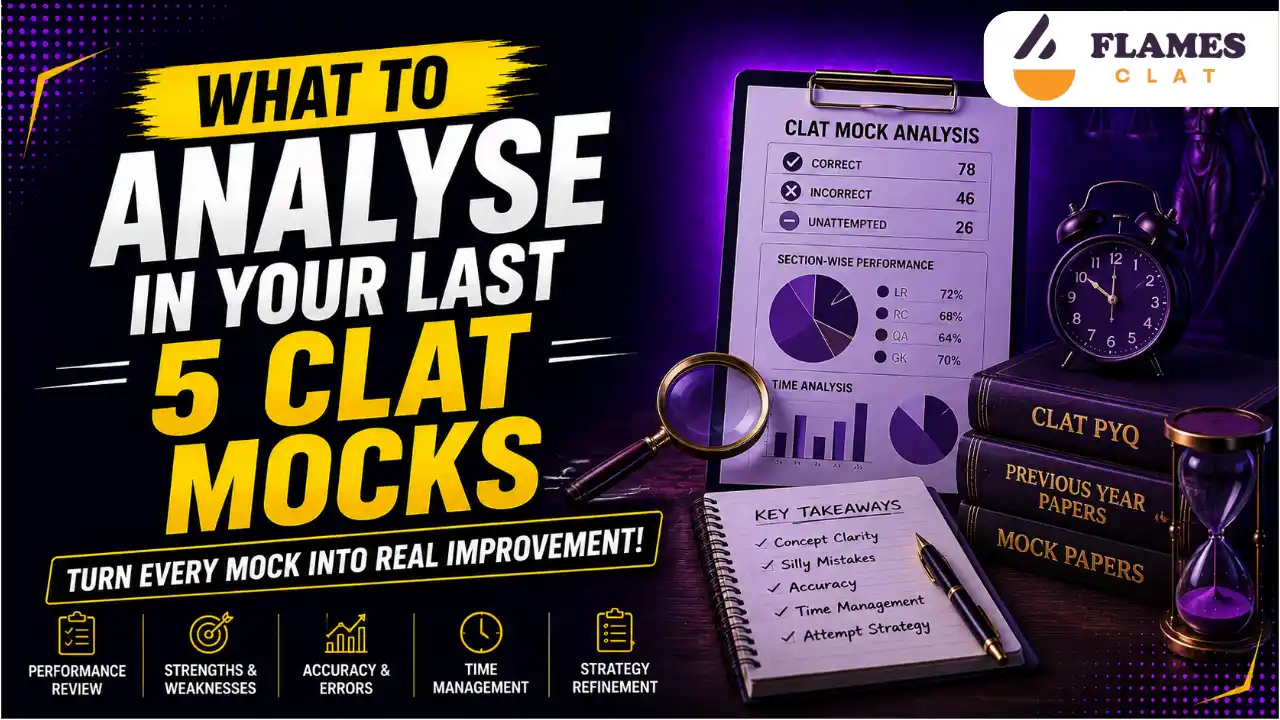
Taking mocks regularly is an important part of CLAT preparation, but simply taking one mock after another isn't enough. If you finish a mock, check your score, look at the answer key, and immediately move on to the next one, you may be missing the most valuable part of the process: analysis. Your last five mocks can tell you much more about your preparation than your highest or lowest score alone.
Don't Look at Only Your Overall Score
The first thing to analyse across your last five mocks is your overall score trend. Is your score gradually improving, staying around the same range, or fluctuating significantly?
Don't panic if one mock is lower than the others. Instead, look at the bigger picture. A single score tells you how you performed on one particular paper. Five mocks can show you your actual pattern.
Also compare your attempts and accuracy. If your attempts have increased but your accuracy has fallen, simply attempting more questions may not be helping your score.
Analyse Each Section Separately
Your overall score can sometimes hide a major weakness.
Look at your performance in English, Current Affairs, Legal Reasoning, Logical Reasoning, and Quantitative Techniques across all five mocks. Identify which sections are consistently strong and which ones keep pulling your score down.
For example, if your English score remains stable but your Quant performance fluctuates heavily, Quant may need more focused practice. Similarly, if your Legal Reasoning accuracy is good but you consistently take too much time, your problem may be speed rather than understanding.
The objective isn't to make every section perfect. It is to know exactly where your marks are being lost.
Check Your Accuracy
Accuracy is one of the most important things to track.
Look at the questions you attempted and the number you got correct. Then ask yourself whether your mistakes are random or whether there is a pattern.
Are you frequently misreading questions? Falling for close options? Making calculation errors? Overthinking? Changing correct answers?
If the same mistake appears across multiple mocks, it is no longer a one-time mistake. It has become a preparation issue that needs to be addressed.
Look at the Questions You Got Wrong
Don't treat every incorrect answer in the same way.
Divide your mistakes into categories. Some questions may have been wrong because you didn't know something. Others may have been wrong because you misread the passage, rushed, misunderstood the question, or chose an option without sufficient evidence.
This distinction matters.
If you didn't know how to solve a Quant question, you may need concept revision. If you knew the concept but made a calculation error, you need more careful practice. If you changed a correct answer to an incorrect one, the problem may be overthinking rather than knowledge.
Analyse the Questions You Left
Your unanswered questions also contain useful information.
Look at the questions you skipped or couldn't reach because of time. Were they genuinely difficult, or were some actually easy questions that you simply didn't have enough time to attempt?
This can reveal whether your problem is question selection, time management, or simply spending too long on earlier questions.
Sometimes improving your score isn't about learning another topic. It is about recovering the marks you are already capable of getting.
Track Your Time
Compare how much time you spent on each section across your five mocks.
Did you consistently spend too long on one section? Did you rush through the final section? Were there particular passages that consumed a disproportionate amount of time?
Also identify your time traps—questions or passages where you regularly spend several minutes without making enough progress.
Once you know where your time disappears, you can start making deliberate changes to your strategy.
Check Your Question Selection
Ask yourself whether you are making good decisions about which questions to attempt and which to leave.
Were there questions you spent too much time trying to solve even though you had very little confidence? Did you skip questions that you could have solved with a little more attention?
CLAT isn't only about solving questions correctly. It is also about choosing the right questions to spend your time on.
Analyse Your Mock-Taking Behaviour
Your performance isn't determined only by knowledge.
Think about how you behaved during the five mocks. Did you panic when a section was difficult? Did one bad passage affect the rest of the paper? Did you start rushing when you saw the clock? Did you lose concentration towards the end?
These patterns matter because the actual CLAT will also test your ability to perform under pressure.
Make a “Top 3 Problems” List
After analysing all five mocks, don't create a list of twenty things you need to fix.
Choose your three biggest problems.
For example:
1. Spending too much time on Logical Reasoning passages.
2. Making careless mistakes in Quantitative Techniques.
3. Poor retention of Current Affairs.
Now your preparation has direction. Instead of randomly solving more questions, you can spend the next few weeks specifically working on these areas.
Your Last 5 Mocks Should Tell You What to Do Next
The purpose of mock analysis isn't to judge whether you're a “good” or “bad” CLAT aspirant. It is to tell you what your next step should be.
Your five mocks should help you answer questions like:
- What am I consistently good at?
- Where am I losing the most marks?
- What mistakes do I repeat?
- Which sections take too much time?
- Am I improving my accuracy?
- Am I making better question-selection decisions?
- What should I focus on in my next week of preparation?
Don't take your next mock simply to get another score. Take it to collect information about yourself.
Your last five mocks are not just five marksheets. Together, they are a record of your preparation—your strengths, weaknesses, mistakes, timing, accuracy, and decision-making.
The real value of a mock isn't the score you get. It's what you learn from it before taking the next one.
Prepare Smarter with FLAMES CLAT
At FLAMES CLAT, we believe that every mock is an opportunity to understand your preparation better, identify your weaknesses, and improve your strategy.
📝 Take the FREE FLAMES CLAT Monthly Quiz:
https://www.flamesclat.com/monthly-quiz
▶️ Watch FLAMES CLAT on YouTube:
https://www.youtube.com/@flamesclat
📲 Join the FLAMES CLAT Telegram Community:
https://t.me/WH6RLT10jpAmH3XR
Don't just take mocks. Analyse them. Learn from them. Improve from them.