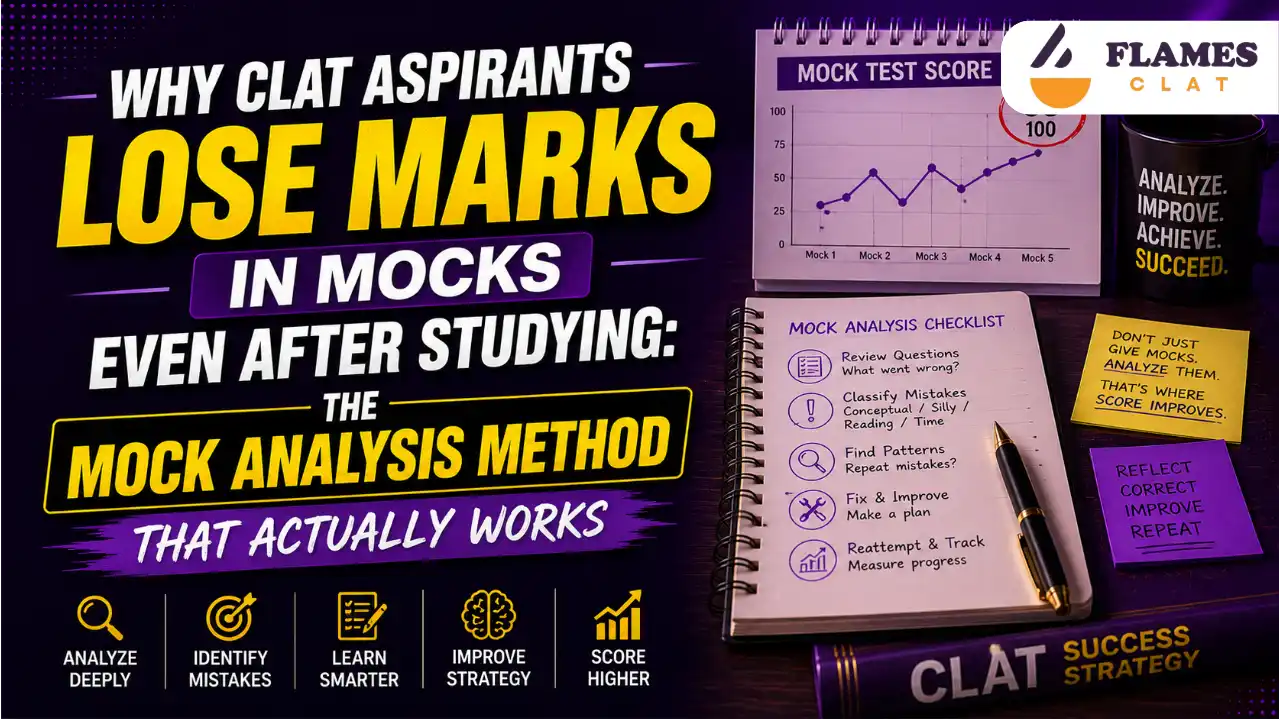
Many CLAT aspirants face the same frustrating situation: they attend classes, complete study material, read the newspaper, attempt questions regularly—and still do not see their mock scores improve.
The problem is often not a lack of effort. It is a lack of mock-test analysis.
A CLAT mock is not merely a test to check your score. It is a diagnostic tool. It tells you where you are losing marks, why you are losing them, and what exactly needs to change before the next test.
Students who only look at their total score repeat the same mistakes. Students who analyse their mocks properly improve with every test.
The Biggest Mistake: Looking Only at the Score
Suppose you scored 62 out of 120 in a mock. That number alone does not tell you whether your performance was good or bad.
A score can fall because of many reasons:
- You attempted too many doubtful questions.
- You spent too much time on one difficult passage.
- You missed easy Current Affairs questions.
- You misunderstood Legal Reasoning principles.
- You made calculation errors in Quantitative Techniques.
- You rushed through the final section.
- You changed correct answers during review.
Unless you identify the exact reason, you cannot fix the problem.
Your score is only the result. Your mistakes are the real data.
The Four Types of CLAT Mock-Test Mistakes
After every mock, classify every incorrect or unattempted question into one of these categories.
1. Knowledge Gaps
These are questions you could not solve because you did not know the relevant topic, concept, current-affairs fact, legal term, or mathematical method.
For example, you may not know a major international event, a constitutional term, or the method required to calculate percentage change.
What to do: Add the topic to a revision list. Revise it within 24 hours and solve at least five similar questions.
2. Reading and Comprehension Errors
These occur when the answer was available in the passage, but you misunderstood the author’s point, missed a qualifier such as “most likely” or “except,” or selected an option that sounded correct but was not supported by the text.
These mistakes are common in English Language, Legal Reasoning, and Logical Reasoning.
What to do: Re-read the passage slowly after the mock. Identify the exact sentence that supports the correct option. Then identify why your chosen option was wrong.
3. Reasoning Errors
These happen when you understand the passage but make an unsupported inference, apply a legal principle incorrectly, or choose an option that is broader or more extreme than the passage allows.
For example, in Legal Reasoning, students often apply their personal understanding of law instead of applying only the principle given in the question.
What to do: Write one line explaining the correct reasoning. This trains your mind to identify the link between the passage, principle, facts, and conclusion.
4. Time-Management Errors
These are the most avoidable mistakes. You may know how to solve a question but lose marks because you spent too long on another question, got stuck in a difficult set, or reached an easy section too late.
What to do: Record the time spent on every section. Identify the section where you lose the most time and set a time limit for it in your next mock.
The 45-Minute Mock Analysis Routine
A mock test should always be followed by analysis. You do not need to spend hours reviewing every question, but you must review the questions that affected your score.
Use this simple 45-minute routine after every CLAT mock:
- First 10 minutes: Review all incorrect answers.
- Mark each one as a knowledge gap, reading error, reasoning error, or time-management error.
- Next 10 minutes: Review unattempted questions.
- Check whether you skipped them because they were genuinely difficult or because you ran out of time.
- Next 15 minutes: Review doubtful correct answers.
- A correct answer obtained by guessing is not a strength. Understand why it was correct.
- Final 10 minutes: Make an action sheet.
- Write down the three most important improvements for the next mock.
Your action sheet may look like this:
- Revise the last two months of international current affairs.
- Practise legal-principle questions involving contracts and torts.
- Limit Current Affairs to 12 minutes in the next mock.
- Avoid changing answers unless there is a clear reason.
How to Know Whether Your Mock Score Is Improving
Do not judge progress only by total marks. Track these four indicators after every mock:
- Attempt rate
- Accuracy rate
- Time spent per section
- Number of avoidable mistakes
For instance, your score may remain the same for two mocks, but your accuracy may improve from 68% to 78%. That means your strategy is working, even if the score has not yet reflected it.
Over time, better accuracy and better time management lead to higher scores.
The Rule of One Improvement Per Mock
Do not try to change everything at once.
If your biggest problem is spending too much time on Legal Reasoning, focus on that in the next mock. If your biggest problem is poor Current Affairs revision, fix that before the next test.
One clear improvement after every mock is more effective than ten vague promises to “work harder.”
Final Takeaway
Mock tests do not improve CLAT scores by themselves. Analysis improves CLAT scores.
Every mock should answer three questions:
- Which questions did I lose?
- Why did I lose them?
- What will I do differently in the next mock?
When you begin treating mock tests as learning tools instead of scorecards, your preparation becomes more focused, your mistakes become fewer, and your confidence becomes stronger.
At Flames CLAT Academy, we help aspirants go beyond attempting mocks. Our mentors help students understand their errors, improve their strategy, and build the consistency required for CLAT success.
Frequently Asked Questions
How often should I attempt CLAT mock tests?
Begin with one full-length mock every week during the early phase of preparation. As the exam approaches, increase the frequency gradually while ensuring that every mock is analysed properly.
Is a low mock score a sign that I cannot crack CLAT?
No. A low score is useful if it helps you identify weaknesses. Your score matters less than the improvements you make after each test.
Should I attempt every question in a CLAT mock?
No. Attempt questions where you can make an informed choice. Blind guessing can reduce your score because of negative marking.
How can I improve my CLAT mock-test score quickly?
Focus on reducing avoidable mistakes, improving accuracy, revising weak topics, and following a fixed section-wise time strategy.
Test Your Preparation with FLAMES CLAT!
Understanding concepts is only the beginning—consistent practice is what turns preparation into success.
If you're serious about cracking CLAT 2027, put your preparation to the test with our FREE Monthly CLAT Quiz. Curated by experienced mentors, the quiz is designed to help you assess your strengths, identify areas for improvement, and experience questions that reflect the latest CLAT pattern.
📝 Attempt the FREE Monthly CLAT Quiz:
https://www.flamesclat.com/monthly-quiz
At FLAMES CLAT, we're committed to helping every aspirant prepare smarter through expert mentorship, comprehensive study resources, mock tests, current affairs updates, strategy sessions, and daily practice content.
Stay connected with us and take your preparation to the next level:
▶️YouTube: https://www.youtube.com/@flamesclat
📲 Telegram Community: https://t.me/WH6RLT10jpAmH3XR
Your journey to a top National Law University starts with the right guidance and consistent effort. Join the FLAMES CLAT community today and take the next confident step towards achieving your CLAT 2027 dream.