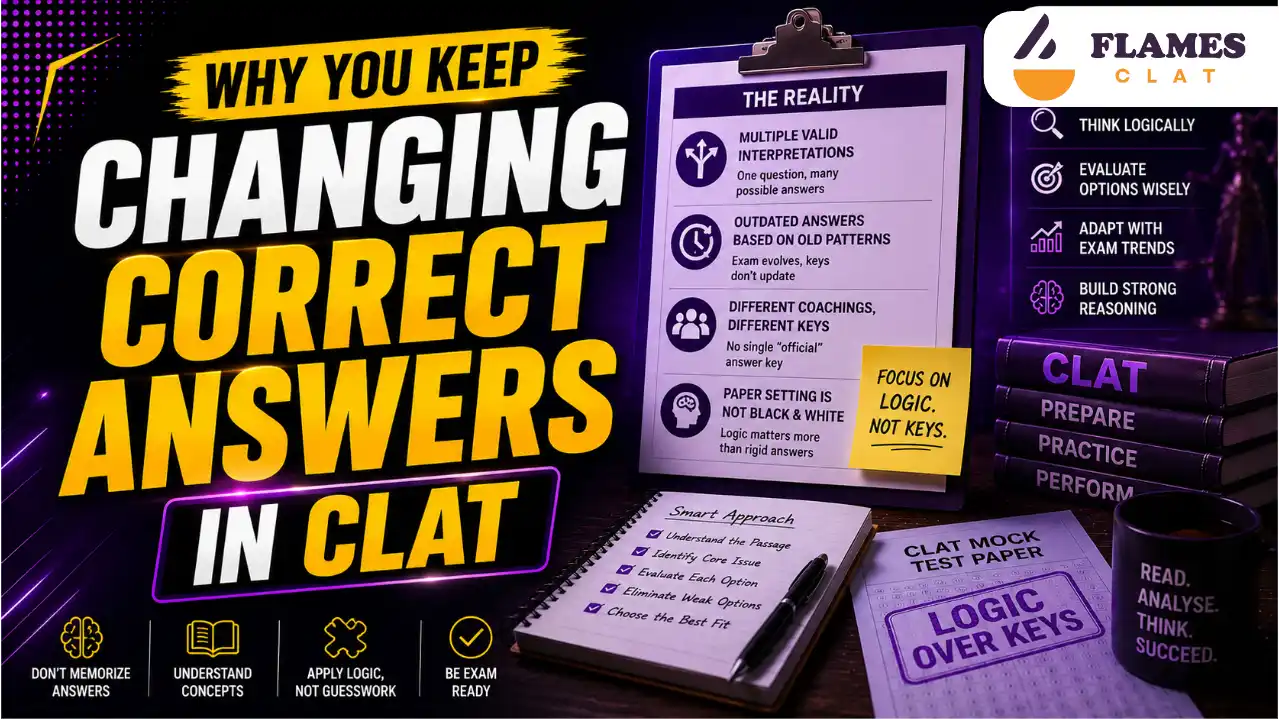
You read the passage, analyse the options, choose an answer, and move on. But when you look at the answer key later, you realise something frustrating: your first answer was actually correct. You changed it at the last moment and lost the mark. If this keeps happening, the problem may not be your preparation it may be overthinking and lack of confidence in your reasoning.
The “Maybe I'm Wrong” Trap
One of the most common reasons students change correct answers is that they start doubting themselves after reaching a conclusion. The moment they see two options that seem somewhat similar, they begin thinking, “What if the other one is actually correct?” This can lead to unnecessary second-guessing. Instead of looking for evidence from the passage, you start looking for reasons to doubt your original answer.
Changing an Answer Without New Evidence
Changing an answer isn't always a bad thing. Sometimes you genuinely notice that you misread the question or overlooked an important detail. The problem arises when you change an answer without finding any new evidence. If your only reason is that the other option “feels better,” you may simply be replacing a reasoned answer with uncertainty. Before changing your answer, ask yourself: “What new information have I found that proves my first answer was wrong?”
If you can't identify anything, think twice before changing it.
Confusing Difficulty With Incorrectness
Sometimes an option feels too simple, while another sounds more sophisticated. Students often assume that the more complicated-looking option must be the better answer. But CLAT doesn't reward answers for sounding intelligent. The correct option is the one that is best supported by the passage and the question. If your original answer is directly supported, don't reject it simply because another option sounds more impressive.
The Fear of Making a Mistake
Ironically, the fear of getting a question wrong can sometimes cause you to change a question you had originally answered correctly.
You may think, “I should check this one more time.” Checking is useful, but repeatedly reopening a question without a clear reason can create unnecessary doubt. Your goal isn't to feel 100% certain about every answer. In a competitive exam, you often have to make decisions based on the strongest evidence available.
Learn From Your Mock Tests
Your mock analysis should include not only the questions you got wrong, but also the questions where you changed a correct answer to an incorrect one.
Make a separate note of these mistakes.
If you notice that this happens repeatedly in Logical Reasoning, Reading Comprehension, or Legal Reasoning, you'll know that your problem isn't necessarily knowledge. It may be decision-making.
Once you recognise the pattern, you can consciously work on it. Use a Simple Rule Before Changing an Answer. Before changing an answer, ask yourself three questions:
Did I misread the question?
Did I find evidence in the passage that contradicts my first answer? Can I clearly explain why the new option is better? If the answer to all three is no, your original answer may still be the better choice.
This doesn't mean you should never change answers. It means you should change them for a reason, not because of anxiety.
Build Confidence Through Analysis
Confidence in CLAT doesn't come from blindly trusting your first instinct. It comes from knowing that your answer is based on a logical process.
When you analyse your mocks, don't just look at the correct answer. Ask yourself how you reached your answer. If your reasoning was sound, even when you eventually changed the answer, recognise that your initial thought process was valuable.
Over time, this helps you develop confidence in your own decision-making.
Changing an answer can sometimes save you from a mistake but changing a correct answer simply because you started doubting yourself can cost you marks that you had already earned.
The solution isn't to blindly stick with your first answer. It is to change your answer only when your reasoning changes.
So, the next time you're tempted to switch an option at the last moment, pause and ask:
“Do I have a reason to change it or am I just overthinking?”
That one question can save you from a surprising number of avoidable mistakes.
Prepare Smarter with FLAMES CLAT
At FLAMES CLAT, we believe that success in CLAT comes from more than knowing the right answers. It comes from developing the confidence to read carefully, reason clearly, and make smart decisions under pressure.
📝 Take the FREE FLAMES CLAT Monthly Quiz:
https://www.flamesclat.com/monthly-quiz
▶️Watch FLAMES CLAT on YouTube:
https://www.youtube.com/@flamesclat
📲 Join the FLAMES CLAT Telegram Community:
https://t.me/WH6RLT10jpAmH3XR
Trust your reasoning. Change only when the evidence changes.